
Floyd Mayweather Jr. Boxing Record Deep Dive and Stats
Why Floyd Mayweather’s 50-0 Record Deserves a Contextual Look
You already know the headline: Floyd Mayweather Jr. retired with an official professional record of 50-0 (27 KOs). That tidy undefeated line is the starting point for most conversations, but it doesn’t fully explain how he became one of boxing’s most dominant and debated figures. To truly understand Mayweather’s legacy, you need to look beyond wins and losses and examine the context in which those results were produced — the weight classes he moved through, the caliber of his opponents, the types of victories he posted, and how his amateur pedigree shaped the fighter who entered the pro ranks in 1996.
In this first part you’ll get an educational framework for interpreting boxing records and a focused look at Mayweather’s amateur background and early professional milestones. These foundations help you interpret later statistics like knockout percentage, rounds boxed, and quality-of-opponent metrics that often appear in deep-dive analyses.
How to Read a Boxer’s Record: Practical Metrics You Should Use
Key statistics that reveal more than the win–loss column
- Total fights and KO percentage: These give a quick sense of activity and finishing ability. For Mayweather, 27 KOs in 50 fights yields a knockout rate around 54%, which signals a mix of technical finishing and selective power rather than pure one-punch knockout dominance.
- Types of decisions: Unanimous (UD), split (SD), majority (MD) or stoppage (KO/TKO) tell you whether wins were definitive or closely contested. Close and controversial decisions can alter how you view an otherwise clean record.
- Quality of opposition: Opponent records, whether they were former or future champions, and their rankings at fight time matter. A win over an elite, frequently ranked opponent carries much more weight than multiple wins over journeymen.
- Titles and weight classes: Multiple divisional titles indicate adaptability. Mayweather is widely recognized for securing titles across several weight classes, which improved the breadth of his resume.
- Activity and longevity: How often a fighter competes and how long they sustain peak performance affect the record’s meaning. Longevity can hide declines but can also highlight consistent dominance over many years.
- Round data and durability: Total rounds boxed, rounds won, and early stoppages help you evaluate stamina, pacing, and late-fight effectiveness.
When you evaluate any boxer, combine these metrics rather than treating the unbeaten streak as a single dispositive fact. Official databases like BoxRec, sanctioning body records, and contemporary fight reports are your best sources for digging into those details. Also be mindful of exhibitions and no-contests; they can be counted differently depending on the source and sometimes confuse public perception.
Tracing Mayweather’s Rise: Amateur Foundations and Early Pro Breakthroughs
You should start with Mayweather’s amateur work to see how his skills developed. He had an extensive amateur career — commonly reported as roughly 80–90 wins with single-digit losses — and capped it with a bronze medal in the featherweight division at the 1996 Atlanta Olympics. That amateur experience provided a technical foundation: defensive mastery, crisp counterpunching, and an elevated ring IQ that would define his professional style.
Turning pro shortly after the Olympics, Mayweather moved quickly through the lower weight divisions. Within two years of his debut he captured his first major world title, a milestone that signaled he could translate amateur success into professional championship-level performance. Early championship wins showed a pattern you can measure statistically: smart fight management, a tendency to win by decision when facing top-skilled boxers, and selective aggression that preserved his undefeated ledger.
- Early title win: Securing a world title early in his career established Mayweather as a top-tier pro rather than a prospect — a data point that amplifies the relevance of subsequent victories.
- Notable early opponents and tests: A handful of close or contentious decisions in the early 2000s demonstrated that while Mayweather often outboxed his rivals, some matchups were narrowly scored, affecting how analysts weight his record.
- Style reflected in the numbers: Low knockout totals relative to some peers, a high proportion of decision victories, and consistent activity across weight classes are all measurable hallmarks of his approach.
With that foundation — what to measure and the key early milestones — you’re ready to examine the middle and later phases of Mayweather’s career, where signature fights, higher-stakes title unifications, and pay-per-view dynamics produce the most debated statistics and narratives.
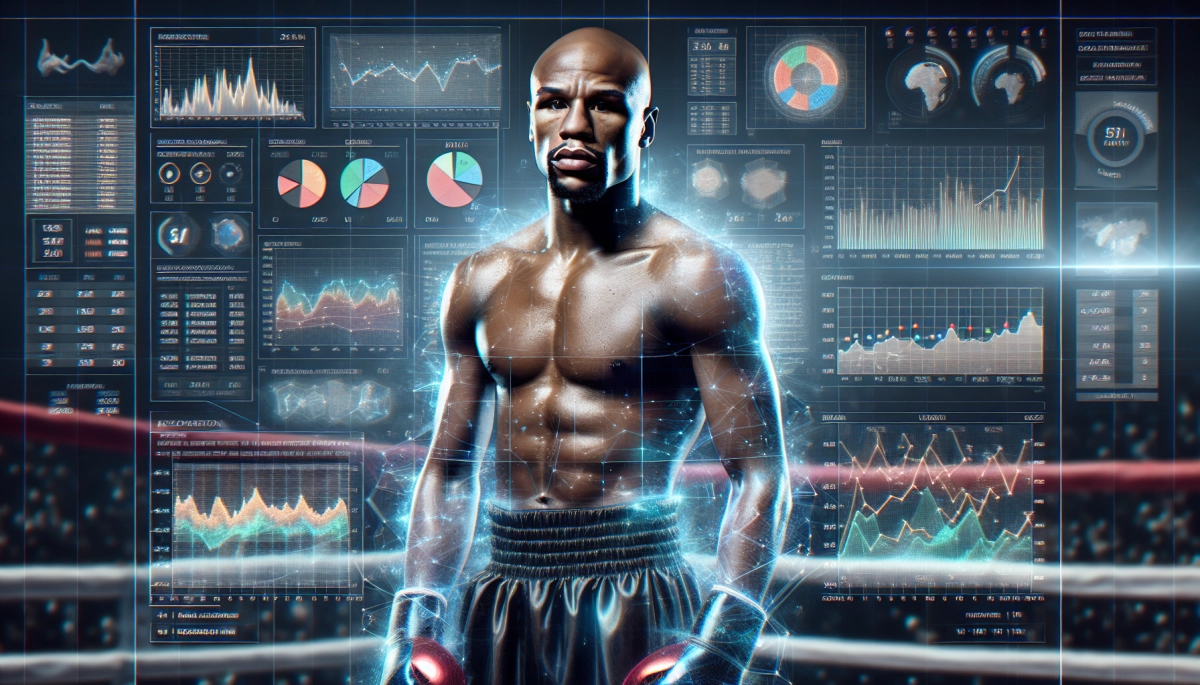
Signature Middle- and Late-Career Fights: Where the Numbers Matter Most
This is the stretch where Mayweather’s record accrued its greatest narrative weight: high-profile opponents, title unifications, and massive pay-per-view gates. Statistically, these fights are the best place to test the unbeaten line because the competition level, media scrutiny, and available data (Compubox, round-by-round scorecards, purse splits) are richest here. Against household-name opponents such as Oscar De La Hoya, Ricky Hatton, Miguel Cotto, Saul “Canelo” Álvarez, and Manny Pacquiao, Mayweather’s outcomes largely reinforced the stylistic story that had emerged earlier — clinical defense, precise offense, and a preference for decision wins when facing elite punchers.
From a numbers perspective, several patterns stand out in this phase. One, his knockout frequency did not spike despite facing larger men as he moved up in weight; many signature wins came by unanimous decision rather than stoppage. Two, punch-statistics analyses repeatedly showed positive efficiency differentials: Mayweather often landed a lower volume than some pressure fighters but did so with higher accuracy and better selectivity, producing favorable landed-to-thrown ratios. Three, the rounds-margin on judges’ scorecards tended to grow in his favor over time, reflecting established ring generalship even when total punch outputs were modest.
It’s also where controversial or close decisions matter most to a legacy assessment. A close scorecard in an early title defense will be weighted differently than a narrow result in a marquee unification bout. Analysts who dig into these fights look beyond the UD/SD label to round-by-round control, pacing across 12 rounds, and momentum shifts — metrics that often explain why many of Mayweather’s biggest wins look convincing even when the final tallies are not lopsided knockouts.
Activity, Matchmaking, and the Business of an Undefeated Record
Mayweather’s record cannot be divorced from the business environment he created around it. Fight frequency, opponent selection, and promotional strategy are measurable forces that shaped the 50-0 line. Over his full career he averaged roughly two fights per year, but that average masks a clear decline in activity as he climbed the ladder and then became a global pay-per-view attraction. After establishing himself as an elite draw, he fought far less often, typically one major event per year — a rhythm that preserved value, minimized exposure to upset, and allowed extensive physical and tactical preparation.
Matchmaking decisions are also quantifiable: later-career opponents were more likely to be established names with marketable styles rather than untested prospects. That raises legitimate questions that statistics can help answer: were those opponents at peak form, or were they past primes? Were rematches and risky stylistic matchups avoided? Analysts combine opponent age, recent records, and rankings at the time of contract to adjust the apparent strength of Mayweather’s resume. Add in the financial lens — huge purses and PPV splits — and you see a rational incentive structure favoring selective campaigning. That selection process is part of the record and should be included as a variable when comparing Mayweather to fighters who fought more frequently or took more high-risk matchups outside of the marquee market.
Advanced Metrics and Modern Reappraisals of Mayweather’s Dominance
Contemporary analytics offer tools that go beyond traditional counting stats. ELO-style ratings adjusted for era and activity, opponent-adjusted win shares, and punch-efficiency models provide richer comparisons across eras and weight classes. Mayweather consistently ranks highly in defensive metrics: low opponent connect rates, high avoidance scores, and favorable damage-limiting indicators derived from punch-type breakdowns (jabs vs. power punches). When converted into opponent-adjusted ratings, his wins against top-tier fighters often translate into significant gains in modeled “win expectation” — evidence that his victories were not mere accumulation but measurable improvements to his standing.
At the same time, these models illuminate limitations: a fighter with fewer stoppages will not score as high on raw finishing indexes, and reduced late-career activity depresses cumulative-win metrics even when per-fight quality is high. Modern reappraisals therefore tend to place Mayweather among the most efficient and outcome-predictable champions, especially defensively, while also recognizing that the 50-0 number is a product of both in-ring mastery and out-of-ring strategy. In short, advanced stats confirm many of the stylistic impressions fans have about Mayweather while supplying a framework to weigh activity, opponent quality, and efficiency on a common scale.

Limitations and Open Questions
Data-driven analysis sharpens many arguments around Mayweather’s record, but it also exposes gaps worth noting. Public punch-counting systems like Compubox are limited by human operators and can undercount certain exchanges; historical fight film varies in quality; and opponent-adjusted models depend heavily on how you weight activity versus peak performance. Beyond raw numbers, qualitative factors — fighter mentality, training camp dynamics, and promotional incentives — remain difficult to quantify but materially affect match outcomes.
- Sample-size effects: fewer fights in the highest-profile years make per-fight averages more influential in any aggregate metric.
- Contextual decay: opponent form, age, and ring rust are often imperfectly represented in ratings and require careful adjustment.
- Measurement bias: visible defensive mastery (e.g., shoulder rolls) may not translate cleanly into punch-stat tallies, underestimating certain skill sets.
Legacy, Numbers, and the Ongoing Debate
Statistical analysis does not put Mayweather’s career into a single box — nor should it. What numbers provide is a structured way to separate verifiable patterns (efficiency, opponent-adjusted value, activity rhythms) from rhetoric. For fans and analysts alike, that separation clarifies which debates are empirical and which rest on values or aesthetics. Ultimately, the 50-0 line is both an artifact of elite in-ring craft and of deliberate career management; understanding both elements is necessary to make fair, evidence-based assessments. For those who want to explore the primary fight records and box-score archives that underpin many of these metrics, databases such as BoxRec remain a practical starting point.
Frequently Asked Questions
Does Mayweather’s 50-0 record automatically make him the greatest boxer ever?
No. The 50-0 record is an important, rare achievement, but “greatest ever” evaluations combine many dimensions: quality of opposition, dominance within weight classes, cross-era comparisons, knockout power, activity level, and subjective judgement about competition and style. Statistics place Mayweather among the most efficient and defensively elite fighters, but they are one input among several in any all-time ranking.
How do advanced metrics change how we view Mayweather’s fights?
Advanced metrics — opponent-adjusted ratings, ELO-style systems, and punch-efficiency models — provide clearer context for each win by accounting for opponent quality, era effects, and per-fight impact. They tend to elevate Mayweather’s standing on defensive and efficiency measures while highlighting that his lower knockout rate affects raw finishing indexes. These tools reduce reliance on simple win/loss counts and help compare across differing activity levels and weight classes.
Where can I find the fight-by-fight statistics mentioned in the article?
Fight-by-fight data can be found in public archives and specialized services: BoxRec maintains bout records and basic stats, Compubox supplies rounded punch-count data for many televised events, and athletic commission reports sometimes include official scorecards and purses. For deeper modeling, researchers combine these sources with film study and opponent-history datasets to construct opponent-adjusted metrics.