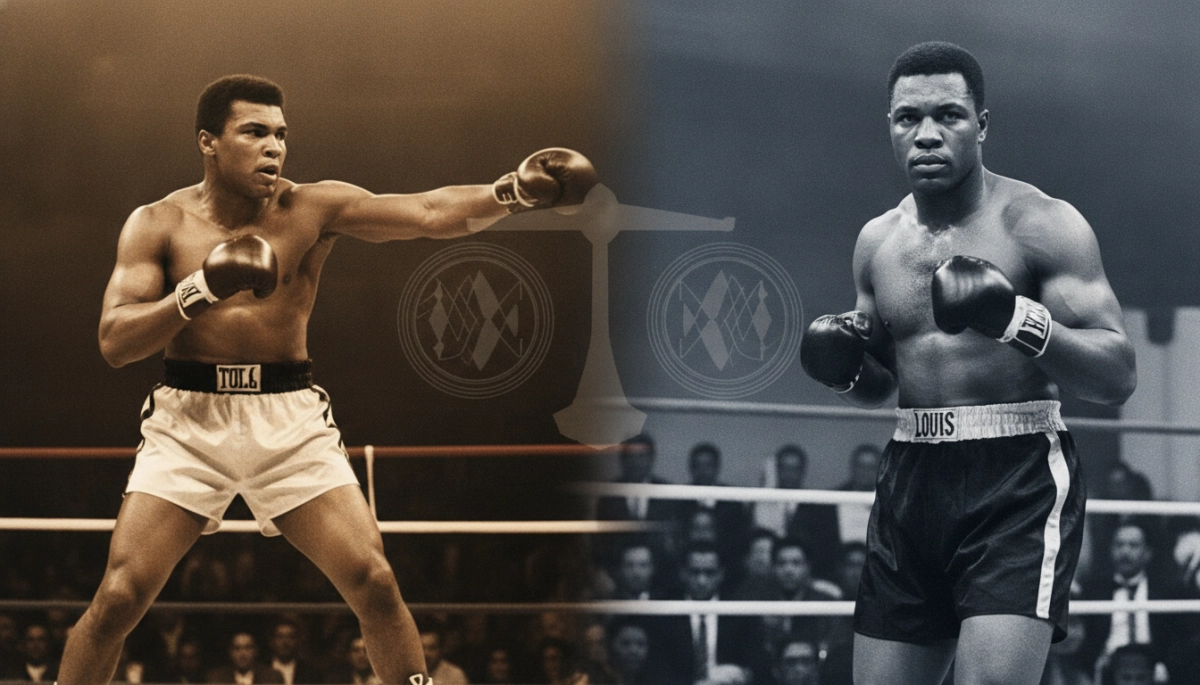
Comparing Greatest Heavyweight Champions: Muhammad Ali vs Joe Louis Analysis
Why Ali and Joe Louis Still Define Heavyweight Greatness
You are about to compare two of boxing’s most consequential heavyweights, and understanding why they remain benchmarks helps frame the analysis that follows. Joe Louis and Muhammad Ali stood on different cultural stages: Louis became a symbol of Black excellence and national pride during the late 1930s and 1940s, while Ali transformed the sport in the 1960s and 1970s through athletic innovation and outspoken social influence. When you measure greatness, you must weigh not only wins and losses but the era, public impact, and how each fighter changed expectations for the heavyweight division.
Paths to the Crown: Early lives and rise through the amateur ranks
You should trace the beginnings of both men to see the roots of their styles and resilience. Joe Louis turned professional in 1934 after a successful amateur run, rising quickly through regional fights to capture the world title in 1937. His ascent coincided with a media landscape that magnified every title defense, making his long reign a unifying storyline for a nation heading into war.
Muhammad Ali, born Cassius Clay, made his mark as an Olympic gold medalist in 1960 and converted his flashy amateur reputation into a pro career characterized by speed and charisma. By 1964 he shocked the boxing world to take the heavyweight crown. You can see early on that Ali’s path relied on superior footwork, timing, and psychological tactics that went beyond the ring.
- Joe Louis: turned pro 1934, world champion 1937, reigned through 1949 with a then-record 25 consecutive title defenses.
- Muhammad Ali: Olympic gold 1960, world champion first won in 1964, known for his speed, reach, and tactical mind.
- Context matters: Louis rose in an era of limited mass media and rigid racial barriers; Ali fought amid television’s boom, civil rights upheaval, and global scrutiny.
Early ring styles and physical attributes that shaped their reputations
From the outset, you can identify how physical gifts and stylistic choices set them apart. Joe Louis was a fundamentally sound, compact puncher with devastating power and economy of movement. He employed a textbook approach: firm stance, precise straight right hands, and an ability to end fights cleanly. Early opponents found him hard to beat because he combined power with clinical ringcraft.
Ali arrived with an unorthodox mix of speed, lateral movement, and psychological warfare. You should note his reliance on reach, jab variety, and quick counters rather than raw knockout power. His “float like a butterfly, sting like a bee” approach unsettled traditional heavyweights and forced you to reconsider the archetype of a champion.
These early contrasts — Louis’s measured power and Ali’s agile finesse — set the stage for comparing championship peaks, signature bouts, and the broader cultural impacts that defined their legacies. In the next section you will examine their most important title defenses and the signature fights that crystallized public and critical opinion about who was greatest.
Signature Battles and Defining Title Defenses
When you isolate the fights that most shaped public and critical opinion, different priorities emerge for each man. Joe Louis’s reign is best understood as a study in sustained dominance. His rematch with Max Schmeling in 1938 transcended sport — a first-round knockout that carried enormous symbolic weight and reassured American audiences on the eve of global conflict. More proximately to the ring, Louis’s long list of title defenses — methodical, efficient, and often short — underlined a champion who punished mistakes and ended contests decisively. His bouts with fighters like Billy Conn (where Conn famously flirted with victory before Louis rallied) and the steady procession of challengers through the late 1930s and 1940s reinforced the image of an almost inevitable champion: patient, technical, and supremely powerful when it mattered.
Muhammad Ali’s signature fights are framed differently: not as a long uninterrupted reign but as episodic reinventions. Beating Sonny Liston in 1964 announced Ali’s arrival as a heavyweight with an unconventional arsenal and compelling persona; the 1965 rematch, clouded by controversial circumstances, intensified debate about legitimacy and finishing instinct. The trilogy with Joe Frazier — especially the 1971 “Fight of the Century” — and the 1974 Rumble in the Jungle against George Foreman are the bouts critics point to when weighing Ali’s greatness. Those fights demonstrated his capacity to absorb frontal challenges to his style and identity: he could be outboxed and adapt (against Frazier and Norton), or use risk‑accepting tactics like the rope‑a‑dope to outlast and outthink a younger, harder hitter (Foreman). While Louis’s defining contests emphasized mastery and closure, Ali’s favored fights displayed drama, narrative, and tactical counterpunching against historical momentum.
Tactical Masterstrokes and the Evolution of Ring Intelligence
Putting their ring intelligence side‑by‑side clarifies why boxing historians often separate ‘technical ace’ from ‘strategic revolutionary.’ Louis built his intelligence around economy and timing: he minimized wasted motion, cut off the ring, and exploited straight punches with surgical precision. His decisions were low‑variance; he didn’t often gamble. That temperament produced a long, low‑risk dominance that relied on positional superiority and knockout leverage rather than elaborate ploys.
Ali’s intelligence was bolder and more performative. He weaponized psychology — taunting, trash‑talking, and showmanship — to unsettle opponents before the first bell. In the ring he layered rapid footwork, varied jabs, and pattern disruption; the rope‑a‑dope versus Foreman epitomized a willingness to invert orthodox boxing logic and trade immediate control for late‑fight opportunity. Ali’s strategic repertoire also adapted to his physical changes: as speed diminished he leaned more on ring generalship and mental attrition, turning resilience into a strategic asset.
Both approaches have costs and rewards. Louis’s conservatism produced fewer headline myths but a cleaner statistical case for dominance; Ali’s innovation created unforgettable moments and tactical paradigms but also made him vulnerable in one‑off matchups and during his forced absence from boxing. These contrasts — steady mastery versus adaptive bravado — are central to understanding why debates about the “greatest” often come down to what kind of greatness you value.
Legacy Beyond the Ring
Greatness in heavyweight boxing resists a single verdict. What Joe Louis and Muhammad Ali share is less a tally of achievements than a lasting influence: each reshaped expectations for champions, altered public conversation about sport and society, and left techniques and narratives that trainers and fans still return to. Debates about who is “greater” will continue because the question ultimately measures values — durability, dominance, innovation, charisma, or cultural impact — more than it measures rounds won.
How to continue exploring this debate
- Watch pivotal fights with fresh eyes: focus on tactics, pacing, and how each fighter handled momentum rather than only the final result.
- Read authoritative biographies and archival coverage to appreciate context; a helpful starting point is Muhammad Ali biography — Encyclopaedia Britannica.
- Compare eras using varied metrics: title defenses, peak performance, adaptability, and cultural resonance. Each metric highlights different aspects of what makes a champion memorable.
In the end, the argument isn’t to crown one immutable “greatest” but to recognize how Joe Louis and Muhammad Ali set standards that invite continual reexamination — a testament to their enduring power inside and outside the ropes.