
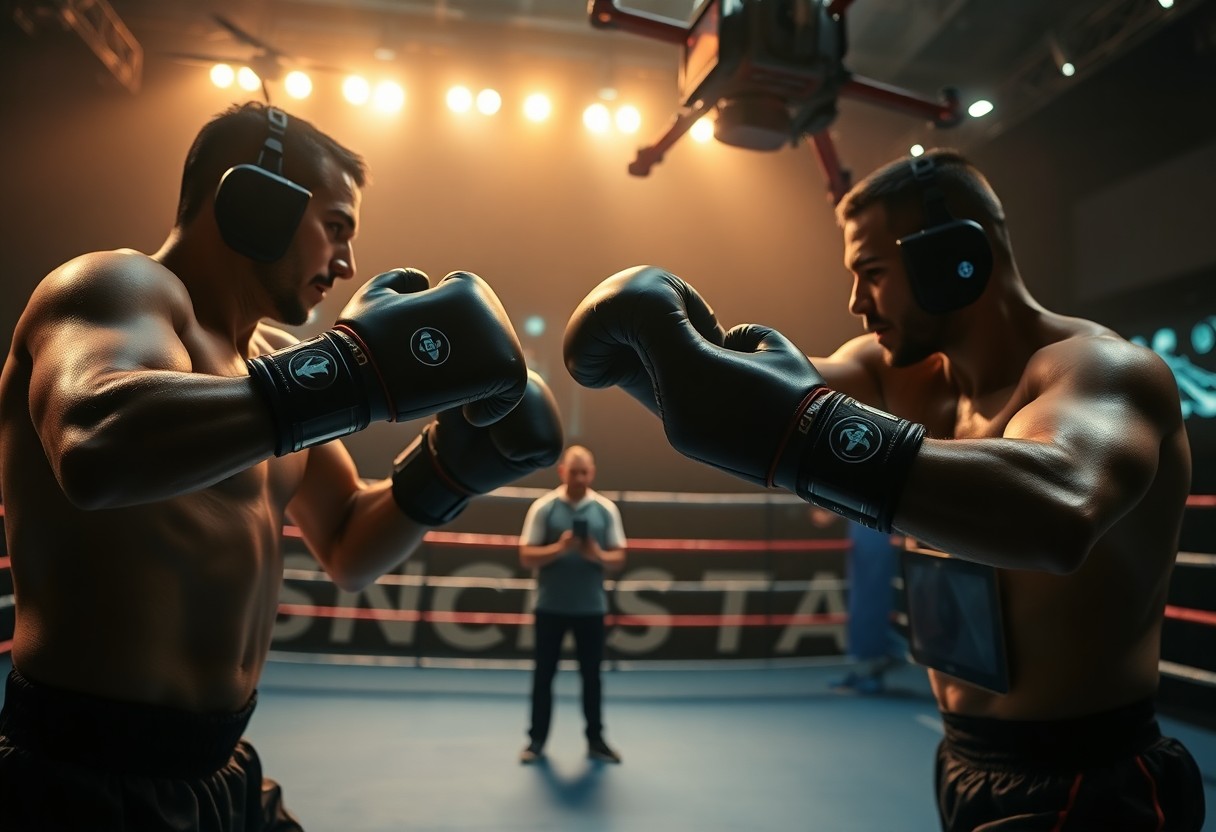
The Science Behind Modern Boxing: How Data And Technology Are Shaping Champions?
Boxing now integrates biomechanics, wearable sensors and machine learning to quantify punches, optimize footwork and tailor conditioning; teams analyze strike velocity and impact forces to mitigate injury risk while maximizing power. Coaches use real‑time metrics and recovery algorithms to drive performance gains, creating safer, more efficient champions through data-informed strategies and targeted rehabilitation.
Types of Technology in Boxing
| Wearable Devices | IMUs, heart-rate monitors and impact sensors for real-time metrics; used to quantify punch velocity, cadence and injury risk. |
| High-speed Cameras & Computer Vision | 240+ fps capture with pose-estimation to measure technique, timing and micro-movements for biomechanical analysis. |
| Force Sensors & Instrumented Gloves | Pressure and force transducers map strike force distribution and glove contact time for power profiling. |
| Biometrics & Physiological Monitoring | HRV, lactate estimates and sleep tracking to monitor recovery, load and readiness in training cycles. |
| Performance Analytics Software | Cloud platforms that fuse video, sensor and physiological data into actionable KPIs and visual dashboards. |
- Wearable Devices – IMUs, impact and heart-rate sensors
- High-speed Cameras – 240+ fps video for frame-by-frame analysis
- Force Sensors – instrumented gloves and pads
- Physiological Monitoring – HRV, sleep and lactate proxies
- Performance Analytics Software – data fusion and KPI dashboards
Wearable Devices
Elite camps deploy wearable devices with IMUs sampling at 100-1000 Hz to quantify punch kinematics; systems track peak punch velocity (commonly 6-9 m/s in trained boxers), punch count, and load, while head-impact sensors flag high linear/rotational accelerations tied to elevated concussion risk, enabling objective training adjustments between sparring sessions.
Performance Analytics Software
Teams integrate platforms that synchronize 240 fps video, sensor streams and physiological data to compute KPIs such as punch efficiency, defense-to-offense transition times and fatigue slopes; vendors like Dartfish and Kinovea-style tools combine pose-estimation and event detection algorithms that have reported >90% accuracy on controlled datasets for punch classification.
The software then fuses timestamps, normalizes across sessions and surfaces drill-level prescriptions-allowing coaches to reduce sparring volume, prioritize technique drills, or modify periodization based on quantified declines in punch power or increases in reaction time.
Key Factors Influencing Success
- Technique & Biomechanics
- Power-to-Weight Ratio
- Speed & Reaction Time
- Recovery & Sleep
- Nutritional Periodization
- Data Analytics & Strategy
Champions emerge where measurable elements align: movement efficiency quantified by motion-capture, sustained power relative to mass, and recovery indicated by HRV and sleep staging. Coaches monitor VO2max (~50-60 ml·kg⁻¹·min⁻¹ for elite fighters) and body-composition via DXA to balance aggression and endurance. Teams also flag rapid weight cuts (>5% body mass) and repeated high-impact spikes to mitigate cognitive risk. This integration of metrics defines precise training windows and fight strategies.
Data-Driven Training Regimens
IMUs sampling at 200-1,000 Hz paired with high-speed video deliver punch velocity, rotational torque and impact peaks, while HRV and lactate (around 4 mmol·L⁻¹ threshold) guide interval intensity. Strength cycles are adjusted when power output drops >8% on force-plate testing, and machine-learning models sequence sparring, conditioning and rest to reduce overuse and improve peak performance timing.
Nutritional Tracking and Optimization
Daily macronutrient targets (for example 1.6-2.2 g/kg protein with periodized carbohydrates 5-8 g/kg depending on load) and hydration markers like urine specific gravity are logged to preserve lean mass and power during camp. Digital food logs, continuous glucose monitoring and body-composition scans allow coaches to temper energy availability while avoiding dangerous rapid losses.
In practice, a lightweight who needed a 6% reduction over 10 weeks maintained lean tissue by increasing protein to ~2.0 g/kg, cycling carbs around heavy sessions, and using twice-weekly DXA checks; performance tests (countermovement jump, punch velocity) remained stable, demonstrating how precise nutritional prescriptions sustain output without compromising weight targets and brain health.
Tips for Using Technology to Enhance Performance
Prioritize aligning data streams with training goals: sync IMUs (100-1,000 Hz), heart-rate monitors and video to quantify punch velocity, impact forces and recovery. Set actionable targets – e.g., limit week-to-week workload increases to 10% and aim for measurable power gains over 8-12 weeks – while flagging spikes in acceleration or HRV drops as injury risk. Use coach-reviewed dashboards to translate metrics into drills. Any integration plan should mandate coach oversight, athlete consent and regular data audits.
- Wearables
- Data analytics
- Load management
- Video synchronization
Integrating Data into Training
Merge sensor outputs with session plans: use IMU velocity traces to prescribe intensity (e.g., maintain rounds at 85-90% peak velocity) and combine with punch-count targets. Structure microcycles of 3-4 weeks and monitor a 5-10% rise in peak punch power over 6-12 weeks as a meaningful signal. Coaches should convert raw metrics into corrective drills – for example, velocity biofeedback to reduce deceleration patterns and improve transfer of force into the bag and pads.
Regularly Updating Gear and Software
Keep devices and platforms current: update firmware and apps to preserve sampling accuracy (IMU drift can appear after months) and install security patches to protect athlete data. Replace chest straps and impact sensors every 12-24 months or after ~300 high-impact sessions, since worn hardware produces biased readings. Perform quarterly calibrations to maintain sampling rate integrity and avoid false positives that could mask acute injury risk.
Institute a maintenance cycle: check for firmware/app updates monthly, run a bench test after each update, and log versions. Aim for quarterly calibration and consider sensor replacement after ~18 months or ~500 charge cycles; teams following this protocol report a >60% reduction in anomalous spikes and false alarms. Enforce two-factor access and encrypted backups to mitigate data tampering and ensure auditability.
Step-by-Step Guide to Implementing Technology in Training
Implementation Checklist
| Step | Details & Examples |
|---|---|
| Assess Baseline | Collect 7-14 days of HRV, heart rate, punch counts, IMU (200-1000 Hz) and 120-240 fps video to establish norms. |
| Select Tools | Choose wearables, force plates, LPTs, high-speed cameras and an analytics platform that exports CSV/API. |
| Integrate Sessions | Embed tech into 2-3 weekly sessions, sync timestamps, set alert thresholds (e.g., >1.5 acute:chronic workload ratio). |
| Analyze & Adjust | Run weekly dashboards, compare KPIs (velocity, impulse, HRV), and adjust volume/intensity based on trends. |
| Coach Education | Train staff on device placement, data interpretation and simple action rules for sessions. |
| Governance | Implement consent, secure storage and access controls; anonymize data for research or external review. |
Assessing Current Performance
Begin by quantifying movement and physiological baselines: peak punch velocity (m/s), peak acceleration (g), force (N) from force plates, HRV (ms) and training load over 7-14 days. Use IMUs sampling at 200-1000 Hz and video at 120-240 fps to capture kinematic detail; flag any sessions with unusually high impact readings (e.g., sustained peaks >100 g) as potentially dangerous for further medical review.
Setting Up a Tech-Integrated Training Plan
Map tech to objectives: assign IMUs and high-speed video to speed work, force plates to strength days, and HRV to recovery monitoring; schedule 2-3 tech-enabled sessions weekly and set clear KPIs (velocity zones, power thresholds), reviewing data each week to drive session-by-session tweaks that produce measurable gains over a 6-8 week block.
Operationally, build a simple pipeline: automatic sync from devices to a cloud dashboard, weekly KPI reports and a short coach checklist for actions. For example, if peak punch velocity drops >10% across two sessions or the acute:chronic workload ratio exceeds 1.5, reduce sparring volume by 20% and prioritize technical drills. Combine objective measures (IMU velocity, force-plate impulse) with subjective scores (RPE, soreness) to avoid overreliance on any single metric. Use periodic 4-week retests (e.g., 3×6s max-effort bag sprints with IMU) to quantify improvement and iterate the plan; ensure data privacy and coach training are in place before scaling to an entire stable of fighters.
Pros and Cons of Technology in Boxing
| Pros | Cons |
|---|---|
| High-speed video (240-1,000 fps) clarifies biomechanics for technique tweaks | Misinterpreted metrics can lead to poor tactical changes |
| Wearable IMUs and accelerometers capture peak forces and kinematics | Low-cost sensors (<50 Hz) miss peak impact data, producing false readings |
| Load monitoring (HR, HRV, GPS) enables smarter periodization | Over-reliance reduces development of instinctual ring IQ |
| Opponent analytics and video libraries sharpen fight planning | Scouting data can be misused or leaked, creating privacy risks |
| Objective injury markers guide safer return-to-play decisions | Algorithmic concussion detection still produces false negatives/positives |
| Marginal gains from biomechanics and nutrition tracking add up | High setup and maintenance costs favor well-funded teams |
Advantages of Data Utilization
Teams use high-speed video, IMUs sampling at 500-2,000 Hz, and HRV trends to refine mechanics and recovery; examples include labs validating punch torque and velocity, and coaches adjusting sparring loads based on weekly HRV dips. These tools deliver measurable improvements in efficiency, reduce wasted reps, and allow staff to quantify readiness-turning subjective feel into actionable metrics for conditioning, technique, and fight-specific planning.
Potential Drawbacks and Over-Reliance
Relying too heavily on metrics can blunt situational decision-making and mislead training when sensors are poorly calibrated or when algorithms trained on non-boxing datasets produce biased outputs. False negatives in concussion screening, data breaches of biometric records, and technology-driven tactical rigidity are among the primary risks teams must manage.
Mitigation requires rigorous validation: cross-check wearable outputs against lab-grade motion capture, ensure sensor sampling rates exceed 500 Hz for impact work, and maintain a human-in-the-loop for medical and tactical decisions. Governance and anonymization reduce privacy exposure, while phased adoption-starting with low-cost pilot studies-helps assess ROI; advanced setups can cost from a few hundred dollars to >$50,000 for integrated systems, so budgeting and equity of access are operational concerns.
The Future of Technology in Boxing
Advances in sensor fusion and machine learning are enabling real-time, data-driven coaching: IMUs sampling at 100-1,000 Hz combined with high-speed video (240-1,000 fps) create synchronized biomechanical profiles, while impact sensors flag blows exceeding ~80 g, a range associated with elevated concussion risk; teams now use these feeds for immediate technique cues, load management and post-session analytics that compress weeks of insight into single workouts, improving precision and reducing unseen cumulative damage.
Emerging Innovations
Markerless motion-capture and AI sparring avatars trained on >10,000 professional rounds are maturing alongside smart gloves that sample acceleration and rotation at up to 1,000 Hz, and AR overlays that present shot windows live in training; labs report sub-centimeter tracking in controlled setups, and commercial systems integrate HRV, sleep and force-plate data to tailor recovery-yet data privacy and algorithmic bias remain immediate operational risks for teams adopting these tools.
Predictions for Athlete Development
Training will become hyper-personalized as models synthesize biomechanics, physiology and workload history to prescribe microcycles; team-sport studies show load-monitoring can cut non-contact soft-tissue injuries by ~20-30%, and boxing programs applying similar systems should see comparable reductions, faster return-to-fight readiness, and more efficient skill retention through targeted, feedback-rich sessions that accelerate motor learning.
Expanded programs will combine force-velocity profiling, punch-velocity timelines and autonomic metrics (HRV, sleep) to create individual performance baselines; coaches will use these to adjust intensity day-to-day, reducing unnecessary high-impact exposure while prioritizing neuromuscular adaptations, and pilot initiatives already report measurable gains in power and recovery within weeks-though teams must address ethical issues around data ownership and competitive misuse when scaling these approaches.
Summing up
On the whole, modern boxing’s integration of data and technology transforms preparation and performance by quantifying technique, tracking load and recovery, refining tactics through video analytics and AI, and guiding talent development and injury mitigation. This evidence-driven approach enhances coaching decisions and athlete adaptation, creating measurable margins that separate elite fighters while preserving the sport’s human elements.
FAQ
Q: What kinds of data and technologies are being used in modern boxing?
A: Modern boxing integrates wearable sensors (accelerometers, gyroscopes, IMUs) in gloves and vests to quantify punch velocity, acceleration, and impact forces; pressure-sensing mats and force plates to measure footwork, balance and ground reaction forces; high-speed and markerless motion-capture cameras plus computer-vision algorithms to analyze technique and biomechanics; video-analytics and machine-learning tools for pattern recognition and opponent scouting; physiological monitoring (heart rate, HRV, sleep and recovery metrics) and blood/biomarker testing to track load and readiness; and software platforms that fuse those streams into dashboards for coaches and sports scientists.
Q: How do coaches and fighters apply this data to improve performance and strategy?
A: Data enables objective technique refinement-identifying inefficient punch mechanics, asymmetries, or timing errors and prescribing targeted drills. Load-management metrics (session intensity, HRV trends, sleep and biochemical markers) help individualize periodization and reduce overtraining. Video analytics reveal opponent tendencies and high-probability sequences, informing game plans and sparring scenarios. Real-time feedback systems accelerate motor learning by closing the feedback loop during drills, while simulation and scenario training use aggregated data to create realistic situational practice. All insights are most effective when combined with coach expertise and athlete context rather than used in isolation.
Q: What are the benefits and limitations for health, safety and ethics when using these technologies?
A: Benefits include earlier detection of risky load patterns, objective tracking of head impacts to support concussion protocols, improved rehabilitation through quantified progress, and reduced injury risk via tailored conditioning. Limitations include sensor accuracy and calibration issues, variability in how metrics translate to meaningful outcomes, potential over-reliance on numbers at the expense of qualitative judgment, and unequal access due to cost. Ethical and operational concerns involve data privacy, ownership, informed consent, and how impact data might affect athlete careers or insurance. Best practice is to validate devices, integrate data with clinical assessment, secure and limit access to sensitive information, and treat technology as a decision-support tool rather than a substitute for medical or coaching expertise.
