The Art Of Traditional Boxing: Timeless Techniques Every Fighter Should Know
It’s in mastering stance, footwork, guard and timing that traditional boxing becomes a discipline every fighter should study. Emphasize precision and economy of motion, developing footwork to control range and defense to avoid dangerous exchanges that can cause serious injury. Combining measured power with tactical timing preserves longevity and builds the technical confidence to win both inside and out.
The History of Traditional Boxing
Tracing its roots to 18th-century England’s bare-knuckle prizefights, organized boxing adopted codified rules with Broughton’s rules (1743) and later the Marquess of Queensberry rules (1867), which mandated gloves and three-minute rounds. Over the 20th century, athletic commissions added weight classes, referees, and expanded medical oversight, reducing fatal outcomes and shifting emphasis toward skill, technique, and formalized scoring systems.
Origins and Evolution
Early contests favored toe-to-toe brawls, yet fighters like John L. Sullivan bridged bare-knuckle daring and gloved technique, accelerating technical ringcraft. Trainers refined the classic stance and footwork, adding angled movement, feints, and systematic conditioning. By mid-century, interval training, targeted sparring cycles, and nutrition plans became standard; contemporary teams layer video analysis and punch-count data to optimize timing and defensive reads.
Influence of Different Cultures
Regional schools created distinct tactical identities: Cuban state programs produced three-time Olympic golds like Teófilo Stevenson and Félix Savón, prioritizing mobility and counterpunching; Mexico emphasizes relentless pressure and devastating body punching, seen in Julio César Chávez’s dominance; the Philippines’ Manny Pacquiao-the only boxer with world titles in eight weight divisions-demonstrates southpaw speed and angle-based offense.
Cross-pollination intensified professionally: the American peek-a-boo system under Cus D’Amato produced Mike Tyson’s explosive entries, while the Philly Shell underpinned Pernell Whitaker and Floyd Mayweather Jr.’s defensive mastery. European schools stress the jab and center control, and modern trainers blend Cuban footwork, Mexican inside work, and data-driven scouting to create adaptable, hybrid fighters.
Key Techniques in Traditional Boxing
Core mechanics split into stance, footwork, guard and striking; mastering these yields reliable timing and power. Adopt a stance that preserves balance and mobility: feet roughly shoulder-width, lead foot angled about 30-45°, and weight distributed to enable quick pushes. Keep the chin tucked and gloves high-exposing the chin invites the most dangerous counters-while using hip rotation and leg drive to generate force rather than arm swing.
Stance and Footwork
Feet should be planted for stability yet ready to move: slight knee bend, heel-to-toe contact, and the ability to pivot ~45° on the ball of the lead foot. Step small-typically 6-18 inches-to close or create range, push off the rear foot for forward bursts, and maintain a high guard when moving. Effective footwork combines balance, angle creation, and consistent head position to avoid counters.
Punching Techniques
Jab, cross, hook and uppercut form the core palette: the jab controls distance and sets up combinations, the cross delivers power via hip rotation, the hook attacks angles, and the uppercut punishes close ranges. Keep the wrist aligned with the forearm and strike with the first two knuckles to prevent injury. Overextending or telegraphing leaves openings for counters.
Train specifics with targeted drills: shadowbox rounds focusing on jab frequency, mitt work for timing, and heavy-bag 3×3-minute rounds for power endurance. Study examples-Joe Frazier’s compact left hook for mid-range damage and Muhammad Ali’s jab-and-lateral-movement combinations for range control. Emphasize snap and hip drive over arm strength; drill wrist alignment and recovery so punches land clean and you return swiftly to a protected guard.
Defensive Strategies
Defense in traditional boxing blends guard, head movement and angle creation to reduce damage while setting counters. Shift weight slightly rearward and keep the chin tucked, slipping punches by 1-2 inches and pivoting 15-45° to break lines; a reaction window of about 0.2-0.3 seconds separates elite defenders from novices. Drill mitt work and 3-minute sparring rounds to test timing under pressure and convert avoidance into immediate counters.
Blocking and Parrying
Use the forearms to absorb body shots and gloves to shield the chin, holding hands at cheekbone level to shorten recovery time. Parry the jab with a sharp 45° wrist deflection, redirecting force and creating a lane for a quick 1-2 counter. Implement 2-minute partner sets-30 seconds slow technique, 90 seconds escalating pace-so the transition from block to counter becomes automatic under fatigue.
Evasion and Movement
Evasion relies on distance, timing and angle work: step offline 6-18 inches, pivot 15-45°, and combine head slips of 1-2 inches to avoid the centerline. Employ the shoulder roll selectively against straight punches, then immediately punish overextension with a short counter; elite fighters practice these sequences in 3-minute mobility-focused rounds to build reflexive responses.
Further development comes from structured drills: ladder/agility work 3x weekly, six shadowboxing rounds with alternating 30-second pivot-only intervals, and four controlled sparring rounds where every evasion must be followed by a counter within two steps. Track success by counting landed counters per round and progressively increase opponent pressure to force adaptation.
Training Methods for Boxers
Balance training across conditioning, strength and ring work with a weekly plan that prioritizes intensity and recovery. Fighters typically train 5-6 days/week, combining 3-5 mile roadwork, HIIT (30s on/30s off) and targeted skill sessions; interval schemes like 10×100m sprints with 60s rest develop anaerobic bursts, while mobility and core routines reduce downtime. Structure blocks in 3-4 week cycles to build and taper for peak performance.
Conditioning and Strength Training
Roadwork and interval sprints form aerobic and anaerobic bases; common templates use morning runs of 3-5 miles three times weekly plus two sprint sessions (e.g., 10×100m). Strength sessions emphasize explosive power-power cleans, trap-bar deadlifts and 5×5 back squats-with plyometrics and medicine-ball throws to convert strength into punch force. Keep reps low, velocity high, and schedule two lower-body and one upper-body strength days per week.
Sparring and Technique Drills
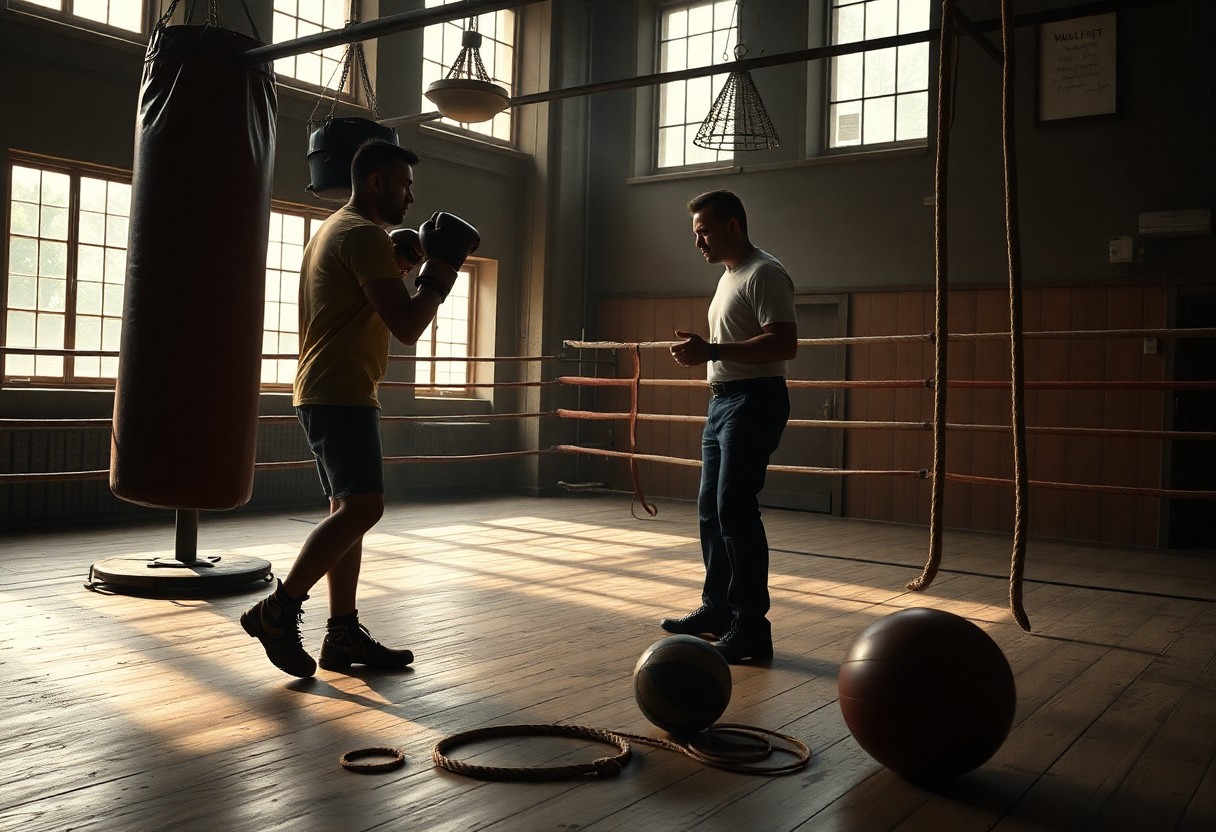
Technical sparring should be frequent but controlled: plan 2-4 sessions/week of 3-6 rounds focused on timing, with only 1-2 full-contact rounds weekly to test durability. Use mitt work, double-end and heavy-bag rotations to train combos and timing; integrate slip-line, ladder footwork and partner drills to create angles. Protective gear and progressive load management lower injury risk.
Start with pad sequences (jab-cross-hook, jab-slip-cross) and defensive-only sparring to ingrain patterns, then increase intensity over a 6-8 week camp: weeks 1-3 emphasize timing and patterning, weeks 4-6 add situational rounds (corner pressure, body-work), and the final phase simulates fight pace with limited full-power exchanges. Coaches should pair drills with video review to correct foot placement, guard collapse and punch selection; progressive overload in sparring, not volume alone, yields the most reliable technical gains.
Mental Aspects of Boxing
Mindset governs split-second choices: studies show trained fighters improve reaction time by ~30 ms after focused drills. Breathing control and pre-round routines regulate adrenaline spikes; 60-90 second visualizations between rounds help rehearse counters and distance. Managing fear of the knockout and sustaining focus through 3-minute rounds separates amateurs from pros.
Focus and Strategy
Focus demands pattern recognition: track an opponent’s lead-hand tendencies during the first two rounds and exploit a 60% predicted response with well-timed feints. Use 3-minute shadow rounds to rehearse angles, aim for 100 purposeful jabs per session, and alternate offensive bursts of 15-20 seconds with measured defense to control tempo, mirroring Mayweather’s pace management.
Overcoming Adversity
After major setbacks, staged recovery proves effective-George Foreman’s 1994 title at age 45 is a clear example of long-term resilience. Implement controlled return-to-spar protocols, specific goal-setting, and team support to reduce relapse risk; confronting the threat of concussion or career-ending injury means using measurable weekly milestones rather than vague timelines.
Implement concrete steps: schedule 6-8 sessions with a sports psychologist to deploy CBT and imagery, keep a daily symptom and training log, and follow a graded return-start with 50% intensity bag work, increase load ~10% per week, and restrict contact sparring to two sessions at 30-40% intensity in month one. Monitor sleep, HRV, and pain scores to mitigate risk of repeat injury while rebuilding confidence.
The Role of Tradition in Modern Boxing
Across gyms and fight camps the old guard still shapes modern tactics: lineages from the Marquess of Queensberry era to Emanuel Steward’s Kronk and Cus D’Amato’s school influence how fighters move and guard. Examples include the shoulder roll used by Floyd Mayweather, the peek-a-boo taught to Mike Tyson, and traditional footwork principles that remain core to angle creation and power transfer in today’s 8-12 week camps.
Maintaining Heritage and Techniques
Daily drills preserve heritage: coaches run focused routines-shadowboxing for 10-15 minutes, 3-6 pad rounds, 4-6 heavy-bag rounds and controlled sparring 2-3 times weekly-to ingrain fundamentals. Oral lineages matter too; gyms like Kronk and Dundee’s camps pass specific timing cues, defensive tapes and tailored mitt patterns from coach to protege so classic counters and timing survive across generations.
Adapting to Contemporary Styles
Modern fighters blend tradition with sport science: interval conditioning, heart-rate monitoring and film analysis refine old drills, while smaller gloves and faster pacing demand tighter defense and quicker counters. Fighters such as Vasyl Lomachenko combine classical footwork with rapid angle changes, and camps routinely use 8-12 week periodization to peak technical output for a fight.
Practically, adaptation looks like mixing 3-6 technical rounds (pads, shadow) with high-intensity interval conditioning and data-driven recovery: GPS/HR zones, targeted plyometrics for hip torque, and force-plate testing to boost punch torque. Coaches monitor load to avoid overtraining and reduce risk of head trauma, while film study quantifies tendencies-how often an opponent drops their lead hand or walks into a right cross-so traditional counters become precision weapons in contemporary rings.
Final Words
From above, mastering traditional boxing demands disciplined repetition of stance, footwork, guard, timing and combinations, combined with conditioning and situational awareness. These time-tested techniques form a coherent system that improves efficiency, defense and counterattacking. Study them methodically, drill under realistic conditions, and adapt principles to your frame and style to maintain their relevance in modern competition.
FAQ
Q: What are the foundational stances and footwork principles every traditional boxer should master?
A: A solid stance begins with balance: feet shoulder-width apart, lead foot angled slightly inward, weight distributed roughly 60/40 on the rear foot for mobility. The chin tucks, hands stay high to protect the face, and the elbows guard the body. Footwork prioritizes small, controlled steps – push from the ball of the rear foot to move forward, step with the lead foot to retreat, and pivot on the lead toe to create angles. Practice shadowboxing with emphasis on entering and exiting punching range, ladder and cone drills for quickness, and partner feeds to drill cutting off the ring; consistent repetition builds instinctive balance and timing while avoiding overextended steps that open you to counters.
Q: Which basic punches and combinations form the core of traditional boxing technique, and how should they be executed?
A: The core punches are the jab, cross (rear straight), lead hook, and uppercut. The jab is a snap from the lead hand to establish range and disrupt rhythm; keep the rear hand protecting the chin when jabbing. The cross drives from the rear foot through a hip and shoulder rotation, maximizing reach and power while retracting the hand quickly. Hooks use torso rotation with a bent arm to attack lateral openings; uppercuts come from the legs and hips to target under the guard. Fundamental combinations include jab-cross, double jab-cross, jab-cross-hook, and lead hook to the body followed by a rear uppercut. Drill each punch on the heavy bag, focus mitts, and in shadowboxing with attention to hip mechanics, hand recovery, and breath control to develop speed, power, and fluid transitions.
Q: How do fighters develop practical defensive skills and effective counters within a traditional boxing framework?
A: Defense in traditional boxing blends passive and active elements: maintain a compact guard, use head movement (slips and rolls), parries, and footwork to control distance, and clinch when necessary to reset. Train specific defensive responses – slip a jab to the outside and return a cross, roll under a hook and counter with a lead hook or rear uppercut, and step offline after a parry to create counter angles. Drills include partner-controlled sparring with rounds focused solely on defense, mitt work that simulates incoming combinations, and reaction drills where a partner randomly throws light punches to force reflexive slips and counters. Emphasize timing and rhythmic control over pure reaction speed; effective counters are born from anticipation, positioning, and the habit of returning fire immediately after a successful defensive action.