Floyd Joy Mayweather — An In-Depth Look at the Stance and Shoulder Roll That Built a Defensive Legacy
Why Floyd Joy Mayweather’s defense matters: what this analysis will teach you
Floyd Joy Mayweather is widely studied for a defensive system that blends stance, the shoulder roll, footwork, distance control, timing and ruthless counterpunching. This article explains the mechanics behind those elements, gives round-level examples from pivotal fights that illustrate how Mayweather applied them in real time, and offers practical, coach-approved drills amateurs can use to start building the same skills safely.
How Mayweather’s boxing stance creates the foundation for defense
Mayweather’s stance is compact, slightly bladed, and weight-distributed to enable instant movement. That posture reduces target surface area while keeping the fighter ready to pivot, step off, or fire counters. For beginners: a compact stance means a high, tight guard, reduced shoulder width, knees slightly bent and weight centered over the balls of the feet for quick reactions.
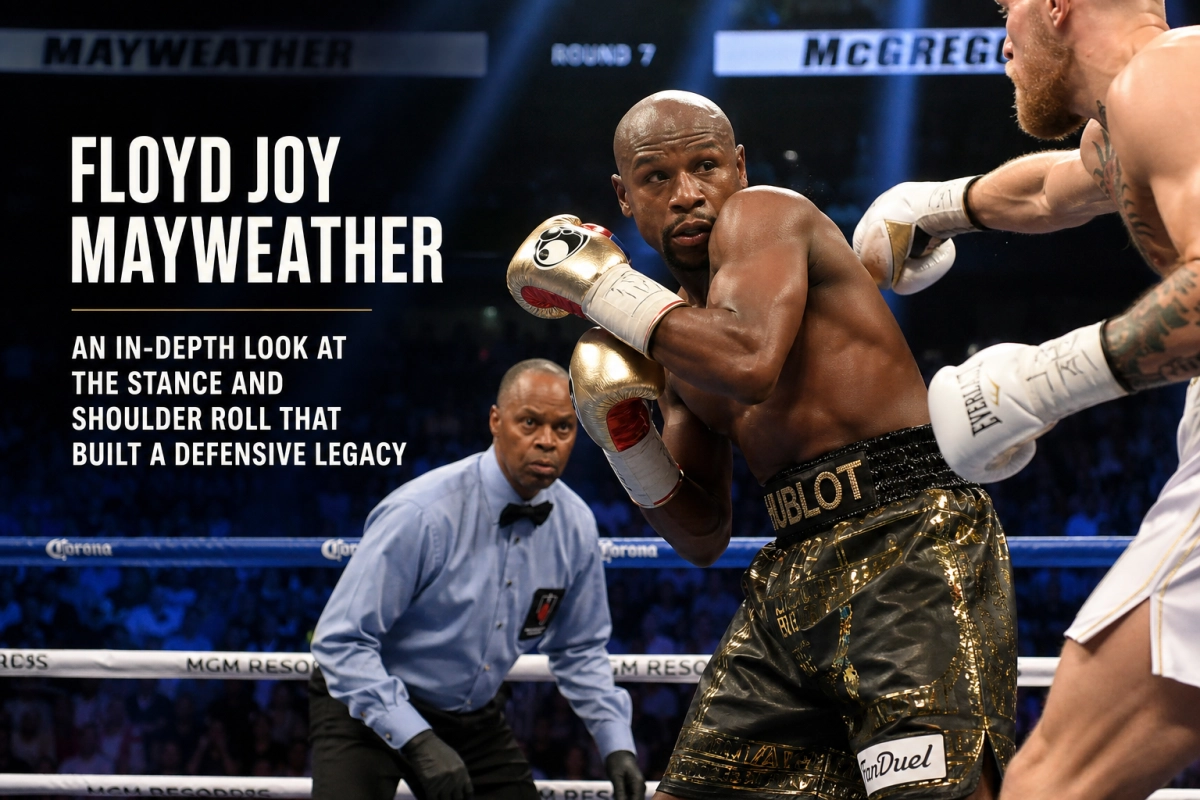
Technically, the stance serves three defensive functions: it angles the torso away from incoming power, it shortens the distance for counters, and it primes the shoulder roll. In practice, Mayweather used a short, upright posture to shift weight between feet and to make his lead hand a probing tool rather than an exposed barrier.
- Lead foot: slightly forward and ready to step out or pivot.
- Rear foot: anchored for explosive weight transfer into counters.
- Hands: chin-protecting rear hand and a mobile lead that parries, feints, and measures distance.
Fight example (stance in action): In exchanges across Mayweather’s 2007 fight with Oscar De La Hoya, his compact, bladed stance allowed consistent lateral movement and quick pivots that frustrated De La Hoya’s attempts to land straight power shots, particularly in the middle rounds where angle changes prevented clean setups.
The shoulder roll: mechanics, fight examples, and beginner drills
The shoulder roll is the centerpiece of Mayweather’s defense: a dynamic technique where the lead shoulder rotates up to deflect a jab or cross while the rear hand stays close to the chin to block follow-ups. Successful rolls require precise timing, head position behind the shoulder, and immediate counter-readiness.
Round-by-round application can look subtle but decisive. For example, in multiple mid-rounds against Canelo Alvarez (2013), Mayweather used shoulder rolls to deflect left hooks and counters with short, snappy right hands before Canelo could reset. Against Marcos Maidana (2014), Mayweather mixed the roll with sharper lateral steps in the later rounds to neutralize Maidana’s pressure.
Coach-approved drills to build the shoulder roll (safe progression):
- Shadow-roll (solo): 3 rounds of 2 minutes practicing the shoulder-up position and immediate right-hand counters while moving on the balls of the feet.
- Partner mitts: slow-paced mitt rounds where the partner throws single jabs and crosses; the trainee practices rolling and firing a one-two return. Emphasize control and head protection.
- Slip-and-roll ladder: combine slip drills with the shoulder roll sequence along an agility ladder to synchronize lower-body timing with the roll.
- Video review: film repetitions and compare posture and head placement to coach feedback; prioritize slow, correct movement over speed.
These foundational elements—stance and shoulder roll—set the tone for Mayweather’s broader defensive system. In the next section, this article will break down how his footwork, distance control and timing tie together to turn defense into scoring opportunities and round-winning strategy.
Footwork: mobility, pivots and ring generalship
Mayweather’s footwork isn’t flashy — it’s deliberate. He uses small, efficient steps to conserve energy while constantly changing angles, cutting off the ring and turning pressure into opportunities. Key components are micro-steps (to maintain balance and readiness), explosive pivots (to create new angles), and weight shifts that allow immediate transfer into counters. Where many fighters use big, telegraphed steps, Mayweather’s feet stay connected to the floor, enabling him to slip a punch and be in position to fire back within a fraction of a second.
Fight examples: In the De La Hoya rematch rounds, Mayweather’s lateral movement and subtle pivots forced straight-line punches into awkward paths and opened spaces to plant quick rights. Against Marcos Maidana (2014), when pressured, Mayweather turned to small pivots and step-offs to avoid being trapped, then used a planted rear foot to fire stinging counters. Even in the Pacquiao fight (2015), where exchanges were more measured, his ability to circle outside of Pacquiao’s punching angles and reset the jab demonstrates ring generalship born from disciplined footwork.
Coach-approved footwork drills:
- Ring-circle drill: set cones 10–12 feet apart in a circle; move clockwise for one minute using micro-steps and maintaining guard, then counterclockwise. Add a pivot every 8–10 steps. Build to 3 rounds.
- Pivot-and-fire: from the guard, have a partner throw a slow jab; execute a 45° pivot off the lead foot and immediately throw a short right hand. Repeat 50 reps per side with coaching feedback.
- Agility ladder with guard: combine ladder footwork patterns (in-outs, lateral shuffles) while keeping hands at chin and throwing a jab every third step to synchronize hands and feet.
- Controlled ring-cutting sparring: light-medium contact, only forward pressure allowed from partner; defender practices stepping off and angling out to score two-count counters before re-engaging.
Distance control, timing and counterpunching: turning defense into offense
Mayweather treats distance and timing as a single layered defense: if you’re in the wrong spot at the wrong moment, you’re a target. He measures opponents with a probing jab and subtle feints, then exploits predictable instincts with delayed counters. The common theme is provocation — invite a predictable response, then punish. His counters are compact, precise and often delivered from behind the shoulder roll, which reduces incoming force while creating a clear line for the return shot.
Round examples: versus Canelo (2013), Mayweather used measured jabs to time Canelo’s lunges and then answered with crisp right counters; the counters were timed to Canelo’s weight shifts, landing as Canelo overcommitted. Against Zab Judah (2006) and Ricky Hatton (2007), Mayweather’s timing was evident in his ability to turn blocks and slips into immediate counters that stopped combinations before they developed.
Coach-approved timing and counter drills:
- Metronome rhythm drill: set a metronome at 60–80 bpm. Jab on beat one, feint on beat two, and counter on beat three. Vary tempo to train adaptable timing.
- Double-end bag timing: work 3-minute rounds focusing on slipping or rolling then exploding with a single counter shot. Concentrate on returning to guard immediately.
- Reaction mitt work: partner randomly releases mitts; trainee must read, parry or roll and fire the pre-practiced counter (e.g., roll + right hand, slip + jab). Keep intensity controlled and emphasize accuracy over power.
- Controlled sparring with counter-only rounds: two-minute rounds where defender may only score with counters off an opponent’s deliberate single-punch attacks — fosters patience and precision.
Developing these attributes requires disciplined repetition and coach feedback. When footwork, distance control and timing are trained together, defense stops being passive and becomes the engine that creates scoring opportunities — exactly how Mayweather built the backbone of his undefeated career.
A four-week progression to build Mayweather-style defense
Week 1 — Foundations: stance and shoulder roll
- Daily shadow-roll: 3 rounds of 2 minutes focusing on compact stance, chin behind the shoulder and slow, deliberate rolls.
- Light mitt work with a coach: single jabs and crosses; practice roll + immediate right-hand reply, 6 rounds of 2 minutes.
- Video review after each session to check head placement and hand position.
Week 2 — Footwork and ring craft
- Ring-circle drill and agility ladder: 3 sessions of 20–30 minutes, emphasizing micro-steps and pivots while maintaining guard.
- Pivot-and-fire repetitions: 4 sets of 50 reps per side with a partner or coach.
- Light movement sparring (no power): practice cutting off ring and angling out of pressure.
Week 3 — Timing, distance and counter combinations
- Metronome rhythm and double-end bag: 3 rounds focused on feel and tempo variation.
- Reaction mitt work: introduce random release patterns; prioritize accuracy of counters over force.
- Counter-only controlled sparring: short rounds where points are scored only by counters off deliberate single-punch entries.
Week 4 — Integration and measured pressure testing
- Combined sessions that mix shoulder-roll drills, footwork cones and timed counter rounds.
- Three technical sparring rounds per session with a coach enforcing pace and safety; focus on applying the full sequence: probe, roll/angle, counter.
- Final week video review and coach feedback to set individual next-step goals.
Closing thoughts on learning from Mayweather’s defense
Adopting elements of Mayweather’s defensive system is less about copying a look and more about cultivating habits: precision in posture, patience in timing, and the discipline to turn defense into offense. Progress will be incremental—small improvements in footwork, a cleaner shoulder roll, or one clearer counter per round are real gains.
Train with measured intensity, prioritize coach feedback and safety, and use video to make objective corrections. Keep workouts structured so each session targets one or two skills rather than trying to perfect everything at once. Over months, those focused reps compound into instincts you can rely on under pressure.
Finally, make the approach your own. Mayweather’s style fits his body, reflexes and mindset; the goal for any amateur is to absorb the principles—compact stance, protected head position, angle creation, patient timing—and adapt them to your strengths. With deliberate practice and good coaching, the defensive habits you develop will not only reduce damage taken but create consistent scoring opportunities that change the dynamics of any fight.