
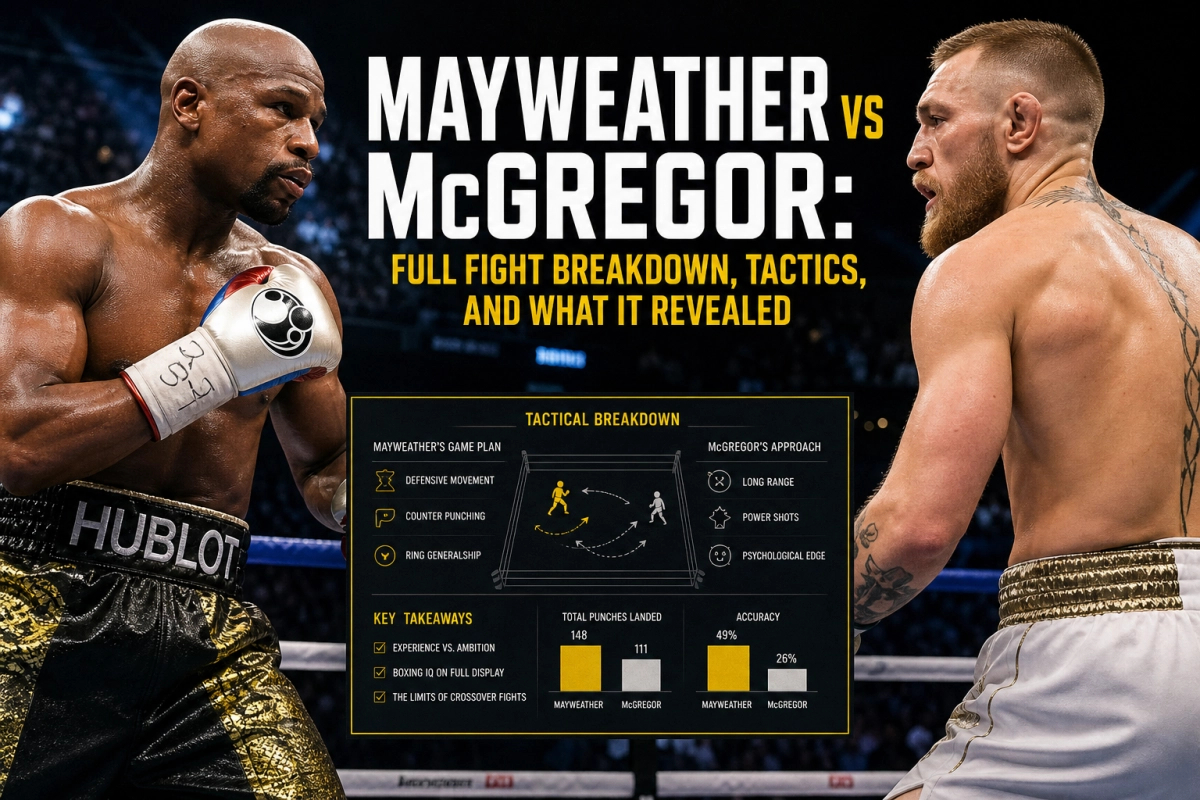
Mayweather vs McGregor: Full Fight Breakdown, Tactics, and What It Revealed
The Night Two Worlds Collided at T-Mobile Arena
On August 26, 2017, the boxing world held its breath as Floyd Mayweather Jr. stepped out of a two-year retirement to face Conor McGregor at the T-Mobile Arena in Las Vegas. A decorated, undefeated pound-for-pound master against a UFC champion who had never fought a professional boxing match — it was a commercial spectacle first, but beneath the hype, a genuine tactical contest was unfolding inside those ropes.
Contested at super welterweight, Mayweather entered at 49-0. McGregor brought an aggressive southpaw stance, a powerful left hand, and a competitive mindset forged through years of MMA competition. What he lacked was the conditioning, technical depth, and boxing-specific experience to sustain early momentum over twelve rounds.
Early Rounds: McGregor’s Surprising Start and Mayweather’s Calculated Patience
From the opening bell, McGregor competed. He used his southpaw stance to create awkward angles, threw his left hand with genuine intent, and used his size to make Mayweather uncomfortable on the ropes. In rounds one through three, he pushed the pace and landed clean shots. His punches were wide and unorthodox, but they carried power, and Mayweather spent those early rounds reading him rather than engaging aggressively.
This patience was entirely deliberate. Mayweather’s strategy was to let McGregor expend energy while gathering information — a tactic he had employed throughout his career. Against a fighter with no professional boxing record, the approach made particular sense. With no tape to study in the traditional way, Mayweather used the first quarter of the fight as a live scouting session.
What McGregor Got Right — and Where the Cracks Began
Credit belongs where it is due. McGregor’s willingness to engage, his confidence under pressure, and his ability to land meaningful punches against arguably the greatest defensive boxer of his generation were genuine achievements. He won several early rounds on unofficial cards and troubled Mayweather in moments a lesser opponent might not have managed.
By rounds four and five, however, the cracks appeared. His punch output declined, his left hand lost authority, and his footwork grew static — classic signs of a gas tank draining faster than anticipated. This is a problem rooted not in willpower but in the specific physical demands twelve rounds of professional boxing places on the body, demands that no amount of general athletic conditioning can fully replicate without years of fight experience.
Mayweather, meanwhile, was finding his rhythm. His jab sharpened, his right hand landed with greater frequency, and he was timing McGregor’s forward movement with precision that only becomes possible once a fighter has processed what his opponent is doing. The momentum was quietly, methodically shifting.
The Middle Rounds: Mayweather Tightens the Vise
Rounds six through nine represented the tactical heart of the fight. Mayweather had completed his assessment, and what followed was a systematic dismantling of everything McGregor had built in the opening exchanges.
His right hand became the primary instrument of control. He timed McGregor’s forward lunges and met them with sharp, compact counters that snapped the Irishman’s head back with increasing regularity. His shoulder roll — the signature defensive mechanism that had frustrated world champions for two decades — was functioning at full capacity, deflecting McGregor’s left hands into glancing blows. The difference between landing on a Mayweather still reading you and one who has already figured you out is considerable, and McGregor was experiencing that firsthand.
McGregor’s body language told the story. Between exchanges he was visibly controlling his breathing, his punch selection narrowed further, and genuine offensive moments became rarer. He was still pressing forward with stubborn refusal to concede ground, but the quality of what he produced had diminished measurably. Mayweather, by contrast, was expending only the energy necessary and banking rounds with quiet, businesslike efficiency.
The Physical Toll and the Referee’s Mounting Concern
As the fight moved into rounds ten and eleven, the cumulative effect of Mayweather’s work became undeniable. McGregor was absorbing cleaner shots with greater frequency, his guard dropping between punches, and his head movement — always limited by boxing standards — had slowed to the point where Mayweather could set his feet and throw with confidence.
This is precisely what Mayweather’s style is designed to produce. He rarely ends fights with one explosive moment. He ends them by making the mathematics impossible — extracting more than he gives, every round, until the deficit becomes insurmountable either on the scorecards or in the body of the man across from him.
Round Ten and the Stoppage: What It Revealed About Both Men
The finish arrived in round ten. Mayweather trapped McGregor on the ropes and unloaded a concentrated flurry of right hands and left uppercuts that left him stumbling and unable to mount a credible defense. Referee Robert Byrd stepped in and waved it off — a technical knockout, the first stoppage loss of McGregor’s combat sports career and the 50th win of Mayweather’s, a number carrying its own symbolic weight.
What the stoppage revealed about McGregor was genuinely interesting rather than simply damning. He had lasted ten rounds with the most defensively accomplished boxer of his era, landed punches no serious observer had predicted, and his chin held under sustained professional boxing fire for the first time. But the fight also confirmed what skeptics had argued: that the specific demands of championship boxing over twelve rounds represent a form of athletic specialization that crosses poorly with even the highest levels of MMA. The gas tank problem was not a failure of general conditioning. It was a deficit only years inside a boxing gym can address.
Mayweather revealed something too — that at 40, two years removed from competition, his core skills remained largely intact. His reflexes had slowed marginally, and McGregor found him with shots a prime Mayweather might have avoided. But the intelligence, the timing, the ability to impose his pace and execute a game plan with patience and precision were fully present. The 50-0 record ended on a performance worthy of the number.
What the Fight Left Behind — and Why It Still Matters
Nearly a decade removed from that August night, Mayweather versus McGregor occupies a complicated but instructive place in combat sports history. In the strictest sense it was a mismatch, a fact the result confirmed. But reducing it to that verdict misses the texture of what actually happened and shortchanges both men.
The tactical story is ultimately a story about specialization. Boxing at the championship level is its own discipline, with its own physiological demands, movement vocabulary, and rhythm — one that takes years of dedicated repetition to internalize. McGregor arrived as well-prepared as any non-boxer could reasonably be, and performed better than the sport’s gatekeepers had been willing to concede. But preparation has a ceiling when the foundational years are absent, and that ceiling revealed itself across ten rounds with clinical clarity.
Mayweather’s performance deserves to be read carefully rather than dismissed as a foregone conclusion. His patience in the opening rounds — that willingness to absorb an uncomfortable start and trust his process rather than react emotionally — was the ring generalship that separates truly elite fighters from merely very good ones. The measure of a great tactical fighter is not just how he performs against perfect opponents, but how cleanly he solves problems he has never seen before.
In the end, what the fight exposed most clearly was not a weakness in either man, but the honest, unforgiving nature of elite sport itself. Preparation matters. Experience matters. Specialization matters. And when those factors converge against you over ten rounds on the biggest stage in the world, even the most formidable will and extraordinary natural gifts will eventually meet their limit. That is not a diminishment of what McGregor attempted. It is precisely what makes what he attempted worth examining this closely.
