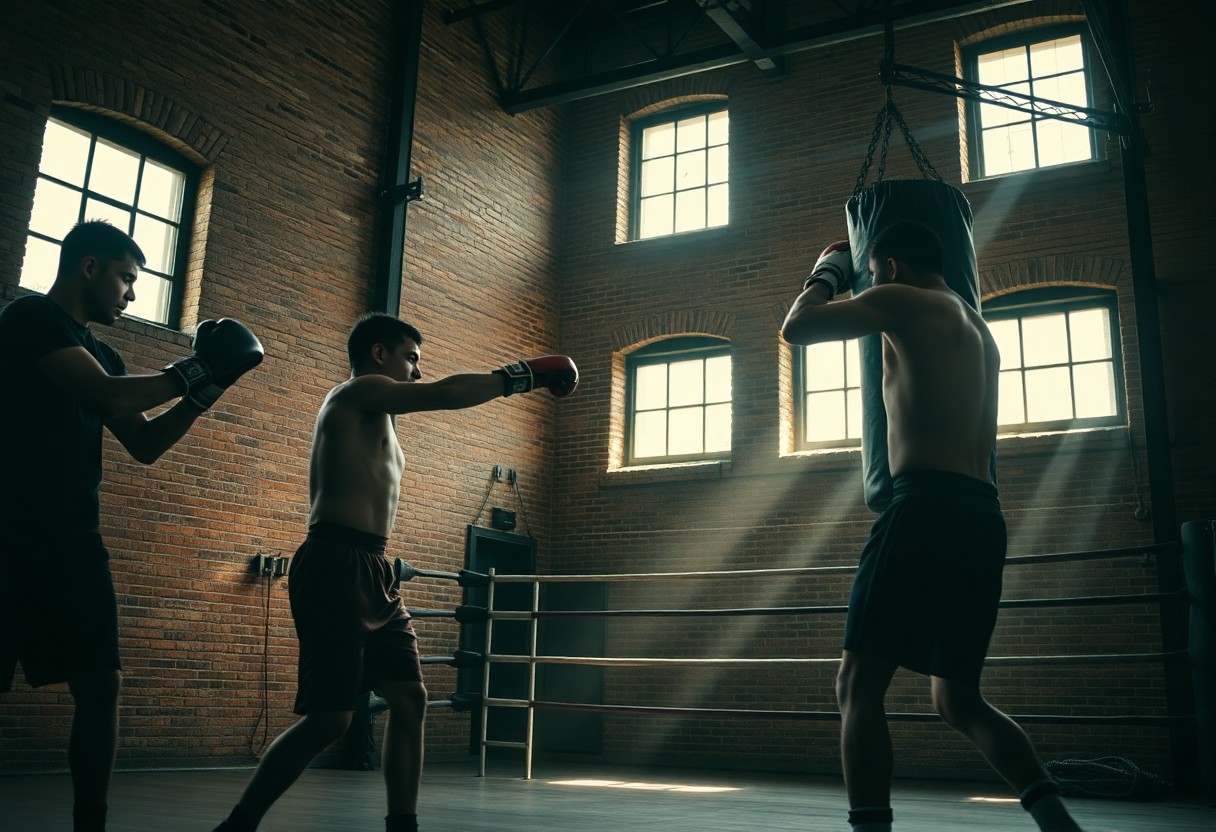
Mastering The Basics: Essential Traditional Boxing Drills For Every Skill Level
There’s a structured path to honing raw ability through time-tested drills that build a boxer’s foundation: basic stance and footwork, shadowboxing for mechanics, heavy bag work for power, and mitt drills for timing. This guide emphasizes injury prevention by teaching proper defense and head movement to reduce risk of cuts and concussions while highlighting how consistent practice delivers measurable gains in speed, power, and ring IQ for beginners to advanced athletes.
Understanding the Fundamentals
Stance, punch mechanics, defense and timing form the backbone of any session; adopt a shoulder-width base with the rear foot turned 30-45° and a slight bend in the knees, distributing roughly 60/40 weight rear/front for balance and mobility. Practice 3-minute shadowboxing rounds focused solely on movement and guard, and run ladder or cone drills twice weekly to ingrain efficient steps-small adjustments in foot placement change reach and recovery by seconds in live sparring.
Stance and Footwork
Orthodox and southpaw setups differ only in mirror image: keep the lead foot pointing slightly inward, rear heel slightly raised for push-off, and avoid crossing feet which makes you vulnerable to sweeps. Move with short 6-12 inch shuffles, pivot on the ball of the rear foot for hooks and angle off using 45° pivots; drill five-cone weaves for 3 rounds to train direction changes and defensive recovery under fatigue.
Punching Techniques
Jab, cross, hook and uppercut each demand distinct mechanics: the jab is a fast range finder and disruptor, the cross uses ~90° hip rotation for power, the hook fires with a ~90° elbow bend and torso snap, and the uppercut drives from bent knees upward through the hips. Combine a crisp 1-2 (jab then cross) to practice timing; stepping into the cross can add roughly 10-20% more force but increases exposure if you overcommit.
Power comes from the kinetic chain-legs to hips to shoulders-so drive the rear foot into the floor, rotate hips, then snap the arm; video slow-motion shows most beginners underutilize the hips, losing measurable force. Train with 100 jabs per round (3 rounds) for speed and 50 heavy bag crosses for power, use mitts to simulate counters, and avoid over-rotation that leaves the back exposed, which is the most dangerous technical flaw to correct.
Essential Drills for Beginners
Progress through focused, repeatable drills that build the four pillars: stance, punch mechanics, defense and timing. Try structured sessions of 3 rounds × 3 minutes-one round for technique, one for controlled power, one for movement and counters. Use measurable goals like 50 quality jabs per round or maintaining heel-toe balance for every pivot to develop consistency and reduce bad habits early.
Shadow Boxing
Shadow work emphasizes rhythm and visualization: perform 3-5 rounds of 2-3 minutes facing a mirror, practicing 1-2, 1-2-3 combos and lateral footwork. Vary tempo-30 seconds slow to ingrain mechanics, 30 seconds fast to simulate pressure. Keep the chin tucked, hands at cheekbone, and track jab frequency (aim 60-100 jabs per session) to build hand speed and defensive reflexes without impact.
Basic Bag Work
Bag sessions convert technique into force: begin with light technical rounds-2-4 rounds of 3 minutes focusing on snapping the jab, rotating hips on crosses, and re-coiling hands-then add controlled power shots. Limit power work to 30-50% effort initially to protect shoulders; overextending repeatedly risks strain. Record rounds to track increases in speed or combo fluency.
Use interval drills such as 20s high-output / 40s active recovery, or 10 straight power shots followed by movement to simulate counter opportunities. Emphasize footwork around the bag, drills like pivot after combo and slipping to the rear side; wear 12-16 oz gloves and wraps to protect wrists, and stop if shoulder discomfort appears to prevent injury.
Developing Speed and Power
Alternate short, high-intensity sets with technical drilling to raise both velocity and force; for example, schedule 3-5 rounds of 3 minutes where minute one emphasizes rapid combos, minute two refines placement, and minute three delivers 8-10 maximal power shots. Emphasize hip rotation and explosive leg drive to transfer energy, keep the guard tight on recoil, and monitor output so technique doesn’t degrade under fatigue.
Speed Bag Training
Start with 2-minute intervals, 3 sets, targeting rhythm and timing-aim for 80-120 strikes per minute. Use wrist flicks rather than shoulder throws, keep elbows at roughly 45 degrees, and cycle singles, doubles and triplets to build alternating hand speed; many athletes see measurable gains in hand-eye sync after 4-6 weeks of consistent practice.
Heavy Bag Drills
Structure heavy-bag work into purpose-driven rounds: one round for combos, one for pure power, one for movement and counters-repeat 3 times. Drive each power punch from the floor up, rotate hips, and snap the shoulder to maximize force; target 8-12 heavy strikes per power sequence to preserve form and reduce injury risk.
Use specific templates: try a “power ladder” (1 jab, 2 crosses, 3 hooks, then back down) for 5 ladders with 30s rest, or perform 10s all-out power bursts followed by 50s movement for 6 rounds to raise anaerobic output. Always wear hand wraps and 12-16 oz gloves, film sessions for technical feedback, and prioritize controlled recovery between maximal efforts.
Improving Defense
Focus on measurable defensive gains by adding targeted sessions: perform 3-5 rounds of 2-3 minute defense work three times per week, split between slip/roll, parry, and footwork drills. Include sets like 60-second slip ladders, 50 parries and controlled clinch resets to reduce head contact and improve recovery. Pay attention to keeping the gloves tight to the face-exposing the chin is the most dangerous error when increasing tempo.
Slip and Roll Drills
Train slips as precise, small movements: execute 6-8 inch lateral slips off jabs and rolls under 45-60° angles for hooks, using a partner or slip bag. Work 3 sets of 2 minutes alternating single-slip, double-slip, then slip-plus-counter (slip, cross, step-out). Emphasize head position over wide arcs-short, efficient motion preserves balance and opens clean counter opportunities.
Parrying Techniques
Parry to deflect rather than stop power; use the forehand for jabs, backhand for straights and a downward swipe for hooks, practicing 50 parries per side per session. Combine each parry with an immediate jab or 1-2 counter to turn defense into offense. Keep elbows in and gloves high-mis-timed or wide parries leave you vulnerable to body shots.
Progress parry training from mitt work to live drills: start with coach-controlled 50-60% pace, then move to slow sparring and finally higher-intensity rounds. Track timing metrics-aim to parry and counter within 0.3-0.6 seconds of impact in drills. Incorporate foot pivots after the parry (plant-step-pivot) to create angles; overcommitting the upper body undermines balance and invites counters.
Sparring Basics
When moving from drills to live exchanges, prioritize controlled intensity and clear objectives: set 2-3 rounds of 2-3 minutes at 50-60% power to drill distance, timing and combinations. Use round-specific constraints (jab-only, no hooks, clinch work) and record simple metrics like landed counters and escapes. Always have a coach overseeing sessions and insist on 16oz gloves and headgear to reduce the risk of concussion.
Controlled Sparring Sessions
Begin sessions with 3×2-minute rounds at 50-60% intensity and 60-90s rest, progressing to 4-5 rounds of 3 minutes as skill and conditioning improve. Assign goals per round-round 1: footwork and jab, round 2: counters, round 3: combination timing-and enforce specific rules for newcomers. Use a consistent safety kit (mouthguard, 16oz gloves, trainer present) and track outcomes with simple tallies: successful counters, defensive recoveries, and positional escapes.
Partner Drills
Pair work should rotate roles in 4 sets of 60-90s: attacker throws controlled 3-punch combos at ~60% while defender practices parries, slips and immediate counters. Incorporate focus-mitt sequences (3-5 rounds of 2 minutes) to work timing and accuracy, and use constraints like “single counter only” to force decision-making. Maintain clear communication and strict contact limits to avoid accidental head shots.
Partner Drills – Further Detail
Drill examples: 1) Slip-and-counter – attacker jabs, defender slips outside and fires a cross; run 6 sets of 30s aiming for ~20 clean counters per set. 2) Stop-start bursts – 15s engagement at 70% with 10s resets to practice recovery and breathing. 3) Signal-target pad work – holder indicates one of three targets for reactive counters. Scale intensity gradually and use headgear and 16oz gloves for heavier contact.
Drills for Intermediate and Advanced Boxers
Elevate training intensity with structured sessions that prioritize timing, precision, and conditioned responses: perform 3-5 rounds of interval work (3 minutes on, 60 seconds off) twice weekly, mix heavy-bag power sets with 2-3 rounds of speed-focused double-end bag, and include technical sparring once per week to test reaction timing under pressure; emphasize clean counters and head movement to turn openings into scoring or stoppage opportunities.
- Advanced shadowboxing with resistance bands for torso rotation
- Heavy-bag intervals: 20s all-out/40s recovery for 8-10 sets
- Double-end bag for rhythm and accuracy
- Pad rounds with randomized calls from coach
- Technical light sparring focusing on counter sequences
- Plyometric footwork and agility ladder circuits
Drill vs Primary Focus
| Drill | Primary Focus |
|---|---|
| Double-end bag | Timing, accuracy |
| Heavy-bag intervals | Power endurance, shot placement |
| Pad work (random calls) | Reaction, combination variety |
| Technical sparring | Strategy, controlled aggression |
| Plyometrics | Explosiveness, foot speed |
Combination Work
Focus on building sequences of 3-6 punches that mix levels and angles: practice 4-6 distinct combos per session, drilling each for 30-60 seconds at full speed and then at 70% to refine mechanics; rotate targets (head-body-head) and include situational combos like the lead uppercut to rear hook, executing these in 3 rounds of continuous partner-pad work to ingrain transitions and counter options.
Reaction Time Exercises
Train split-second responses with drills such as randomized mitt calls, a double-end bag, and a 2-person slip-rope-run 8-12 short bouts (20-40s) focusing on immediate defensive action then percussion counters; integrating strobe-glass training or reaction-ball sessions 2-3 times weekly sharpens sensory processing and reduces hesitancy during exchanges.
Expand reaction training by structuring progressions: start with predictable rhythms (10×20s) then introduce randomness (coach calls, light feints) and finally pressure tests in technical sparring; try a sample block-4 weeks of 3 sessions/week (double-end bag 3×3min, 5×30s reaction drills, 6×20s strobe work)-and log response times and successful counters to quantify improvement and adapt drills for deficits in lateral movement or visual focus.
Conclusion
Upon reflecting on the role of foundational drills in boxing, consistent practice of stance, footwork, jab mechanics and defensive movements builds a reliable skill set that supports advanced training; disciplined repetition, adaptability and focused feedback accelerate progress for beginners through experienced fighters.
FAQ
Q: What foundational traditional boxing drills should every beginner practice to build a strong base?
A: Begin with stance and footwork drills, shadowboxing, jump rope, heavy-bag work, speed-bag timing, and basic pad/mitt sessions. Drill specifics: – Stance & footwork: 10 minutes daily of step-and-slide, pivoting, advancing/retreating drills (3-5 sets of 1-2 minutes). – Shadowboxing: 3 rounds × 3 minutes focusing on form, guard, head movement, and simple 1-2/1-2-3 combinations. – Jump rope: 5-10 minutes for rhythm and coordination (intervals: 30s on/15s off). – Heavy bag: 4 rounds × 3 minutes working single-punch accuracy, straight punches, and basic combinations. – Speed bag: 3 rounds × 2 minutes for timing and shoulder endurance. – Mitt work or partner drills: 2-3 rounds reinforcing technique and target placement. Emphasize slow, deliberate technique first, then increase speed and power as mechanics improve.
Q: How should drills be progressed for intermediate and advanced boxers without compromising fundamentals?
A: Increase complexity, intensity, and specificity while preserving technical focus: – Intermediate: add combination variety, defensive counters, longer rounds (4-6 × 3 minutes), introduce interval sprints, double-end bag for timing, and structured mitt sessions with reactive targets. – Advanced: incorporate high-intensity interval rounds (8-10 × 2-3 minutes), situational sparring (entry/exit, clinch control), power rounds on heavy bag, plyometric and Olympic-style throws for explosive hip drive, and reaction/tactical drills with unpredictable inputs. Progress by manipulating volume (rounds/reps), intensity (pace/load), and variability (unplanned partner cues). Track fatigue and technique breakdown; scale back if form degrades.
Q: How do I prevent injuries and structure a weekly plan that integrates these traditional drills effectively?
A: Prioritize warm-ups, mobility, recovery, and progressive loading: – Warm-up: 8-12 minutes of dynamic mobility, light shadowboxing, and activation drills before intense work. – Recovery: cooldown, static stretching, foam rolling, sleep, hydration, and nutritional support. – Injury prevention: balance pushing work with posterior-chain strength, shoulder stability, and hip mobility sessions 2× weekly; manage volume and avoid excessive repetitive-loading without rest. Sample weekly templates: – Beginner (3 days): Day A – technique (shadow + footwork + mitts), Day B – heavy bag + conditioning, Day C – sparring fundamentals/light partner work + jump rope. Add 2 active-recovery days. – Intermediate (5 days): 3 technical/skill days (shadow/mitts/heavy bag), 1 high-intensity conditioning day, 1 light sparring/tactical day, 1-2 mobility/rest days. – Advanced (6+ days): 3-4 high-skill sessions (mitts, heavy bag, tactical sparring), 1 strength/power session, 1 conditioning interval session, 1 recovery/mobility day. Monitor joint soreness and performance; reduce intensity or volume when signs of overuse appear.