How Floyd Mayweather Built His Perfect 50-0 Record Across Five Weight Classes
The Making of a Perfect Record: Floyd Mayweather’s Rise Through the Divisions
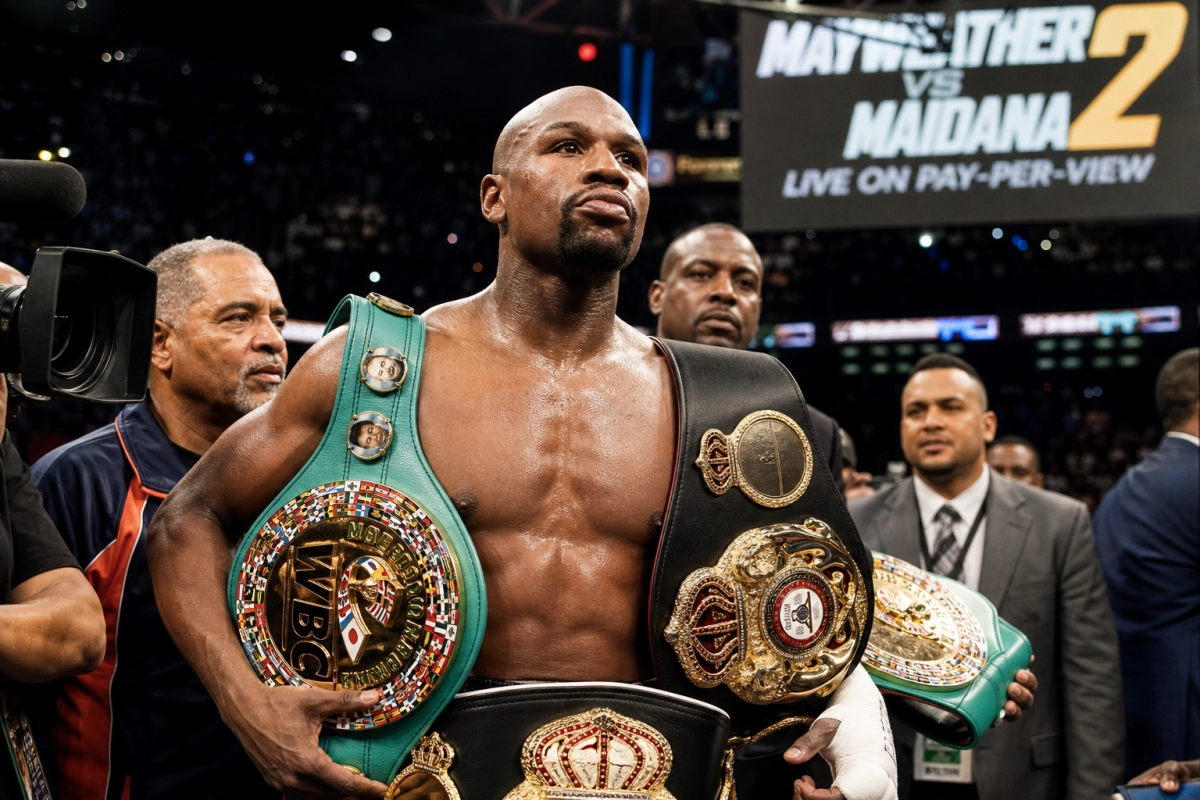
No professional boxing record in the modern era has generated more debate, admiration, or scrutiny than 50 wins and zero losses. Floyd Mayweather did not stumble into that number — he constructed it with extraordinary deliberateness, fight by fight, weight class by weight class, across nearly two decades. Understanding how that record was built requires more than listing opponents. It demands a close look at timing, matchmaking, and the tactical intelligence that defined Mayweather from the very beginning.
Born into a boxing family in Grand Rapids, Michigan, Mayweather carried the sport in his bloodline before he ever laced up gloves professionally. His father, Floyd Sr., and uncle Roger were both professional fighters, and Roger would become one of the most important figures in Floyd’s corner. That environment shaped not only his physical development but his understanding of boxing as a craft rather than simply a contest of power.
From Olympic Bronze to Professional Dominance at Super Featherweight
Mayweather turned professional in 1996 following a decorated amateur career that included a bronze medal at the Atlanta Olympic Games. He lost a controversial decision to Serafim Todorov in the semi-finals, but the experience sharpened his competitive edge. He entered the professional ranks with something to prove and a technical foundation that few fighters his age could match.
His early super featherweight fights showcased the defensive framework that would define his entire career. The shoulder roll — using the lead shoulder and a tight guard to deflect punches while remaining in range to counter — became his signature tool. It requires exceptional timing, reflexes, and ring intelligence. To beginners it can look almost passive, but it is an aggressive defensive posture designed to invite punches and punish opponents for throwing them.
His first major world title came against Genaro Hernandez in 1998, a WBC super featherweight championship fight that ended in a technical knockout in the eighth round. Hernandez was a skilled, experienced champion, but Mayweather’s speed, accuracy, and movement dismantled him methodically — an early signal that this was not an ordinary champion in the making.
Building a Foundation on Technical Supremacy
What separated Mayweather during this phase was not knockout power, though he could hurt opponents when necessary. It was his ability to control every dimension of a fight — distance, pace, angles, and rhythm. Opponents frequently described fighting him as deeply disorienting, as if the ring itself kept shifting beneath them.
His record grew steadily through this period, with defenses against credible challengers keeping his title relevant and his skills sharp. By the time he began looking toward the lightweight and welterweight divisions, he had already mastered the fundamentals of championship boxing in a way that most fighters never fully achieve.
The Lightweight Era and the Art of Strategic Ascent
Mayweather’s move up in weight was never rushed. Where other fighters chase bigger names or bigger paydays at the expense of readiness, Mayweather treated each divisional transition as a deliberate recalibration. He refined his angles, adjusted to heavier punches, and gave himself time to neutralize new threats before they became liabilities.
Fights against Diego Corrales and José Luis Castillo cemented his standing as the best pound-for-pound fighter in the world. The Corrales stoppage demonstrated his capacity for calculated aggression. The two bouts with Castillo — rough, physical fights where Mayweather was genuinely tested — revealed something equally important: he could adapt under pressure. Castillo pushed him in ways few opponents had managed, and Mayweather responded not by abandoning his system but by refining it mid-fight. That kind of in-ring intelligence is extraordinarily rare.
The Separation from Top Rank and the Road to Full Control
Perhaps no decision proved more consequential to the shape of Mayweather’s record than his split from promoter Bob Arum and Top Rank in 2006. What emerged was something unique in the sport’s history: a fighter with near-total control over his own promotional destiny. Mayweather founded Mayweather Promotions and began managing the architecture of his career in ways no fighter of his caliber had done before.
This autonomy had direct implications for 50-0. Mayweather could negotiate fight terms, select opponents, and dictate timing. Critics argued — sometimes fairly — that this control allowed him to avoid certain opponents at their peak. Supporters counter that every elite fighter makes strategic matchmaking decisions, and Mayweather simply had more leverage to act on them openly. Both perspectives contain truth.
What is beyond dispute is that the fights he chose were not soft touches. Oscar De La Hoya, Ricky Hatton, Shane Mosley, Miguel Cotto, and Manny Pacquiao represent some of the biggest names the sport produced in that era. Each fight carried genuine risk and required Mayweather to perform at an elite level against a motivated, capable opponent.
Weight Classes as Chess Moves: The Welterweight Consolidation
By the time Mayweather settled at welterweight and junior middleweight, the record had begun to take on a life of its own. It was no longer simply a statistic — it was a marketing instrument, a psychological edge, and a historical marker that shaped how opponents prepared and how the public perceived each contest.
The opponents he faced at welterweight tested different aspects of his skill set:
- De La Hoya brought size, power, and a massive promotional platform that made the fight a cultural moment as much as a sporting one.
- Hatton brought relentless pressure and body work designed specifically to smother Mayweather’s defensive system.
- Mosley brought elite hand speed and knockout power, landing the hardest shots of Mayweather’s career before being broken down over the championship rounds.
- Cotto brought championship pedigree, physical strength, and dogged persistence that made him one of the era’s most respected welterweights.
- Pacquiao, whatever one’s view of how the fight unfolded, was the most anticipated boxing match in a generation and carried a pressure that no amount of preparation can fully simulate.
Each encounter required Mayweather to solve a specific problem under the most intense conditions possible. That he did so without a single loss speaks to a consistency of execution that sits at the heart of what made 50-0 achievable. Talent explained the early wins. Discipline, preparation, and an almost clinical approach to self-preservation explained the later ones.
The Final Fights and the Weight of an Unfinished Number
Mayweather came out of retirement twice in the final chapter of his career, each decision carrying the unmistakable fingerprint of his career-long philosophy: fight on your terms, or do not fight at all. The bout against André Berto in 2015, bringing the record to 49-0, was criticized for the quality of the opponent, but it served a precise purpose — a low-risk platform to equal and surpass Rocky Marciano’s storied 49-0 record. The criticism was understandable. The logic was impeccable.
Then came Conor McGregor in 2017, a crossover spectacle that drew more mainstream attention than any boxing match in years. McGregor was not a professional boxer of comparable standing, and Mayweather knew it. The fight represented a flawless final act of brand management — a globally televised performance that brought the record to 50-0 while generating revenue that dwarfed almost any fight in history. Whether one views it as a legitimate addition to a serious legacy or a commercially motivated exhibition says a great deal about how each person defines the sport itself.
What 50-0 Actually Means in the Long View of the Sport
The honest assessment of Mayweather’s perfect record is neither the uncritical celebration his most devoted supporters offer nor the dismissive revisionism his harshest critics prefer. Mayweather fought in an era of fragmented titles, promotional politics, and television deals that complicated certain matchups. Some fights the public wanted never materialized until both men were past their peaks. These are legitimate observations — and also true, to varying degrees, of nearly every great champion in history. Judging Mayweather by a standard no predecessor was held to would be its own form of distortion.
What the record does represent, without qualification, is an unbroken chain of elite-level performance sustained across an extraordinarily long career. The defensive system he refined held up not just in his twenties, when reflexes are sharpest, but through his late thirties, when even slight physical decline can be catastrophic for a fighter whose entire game depends on timing.
Boxing has produced fighters who were more exciting, who hit harder, who captured the imagination more completely in their prime. What it has not produced, in the modern professional era, is a fighter who managed the intersection of competitive achievement, self-preservation, and career longevity with such precision. That combination — not any single quality in isolation — is what made 50-0 not just possible but, in retrospect, almost inevitable.
The record stands. The debate around it will continue for as long as serious people love the sport. And that, perhaps, is the most fitting legacy of all for a fighter who always seemed to understand that controlling the conversation was just as important as controlling the ring.