Floyd Mayweather’s Tactical Genius: How He Controlled Range, Pace, and Ring Space Against Every Style
The Blueprint Behind an Unbeaten Career: Understanding Mayweather’s Ring Intelligence
Very few fighters in professional boxing history have retired with a perfect record, and fewer still have done it against the depth of opposition Floyd Joy Mayweather faced across five weight classes. But the 50-0 record is only the surface of the story. What made Mayweather genuinely exceptional was not raw power, speed alone, or an iron chin. It was the ability to systematically dismantle any fighter by controlling the fundamental variables of every round before his opponent could impose their own game plan.
Range, pace, and ring space are concepts every serious student of boxing learns early, but mastering all three simultaneously against world-class opposition requires a level of spatial awareness and in-fight problem-solving that separates elite champions from all-time greats. Mayweather operated where tactics became instinct. He did not simply react to opponents — he dictated the conditions under which they were allowed to compete.
Range Control as a Weapon: Why Distance Was Never Neutral in a Mayweather Fight
In boxing, range determines who can land punches effectively, who must move first, and who carries the psychological pressure of the moment. Most fighters treat range as a condition they adjust to. Floyd Mayweather treated it as a weapon he owned.
His shoulder roll defense — developed under trainer Floyd Mayweather Sr. — was central to his range management. By angling his lead shoulder forward and keeping his rear hand close to his chin, he could deflect incoming punches while remaining close enough to counter. This positioning was not passive. It was a calculated invitation, designed to draw opponents into a distance where they felt confident but were actually most vulnerable.
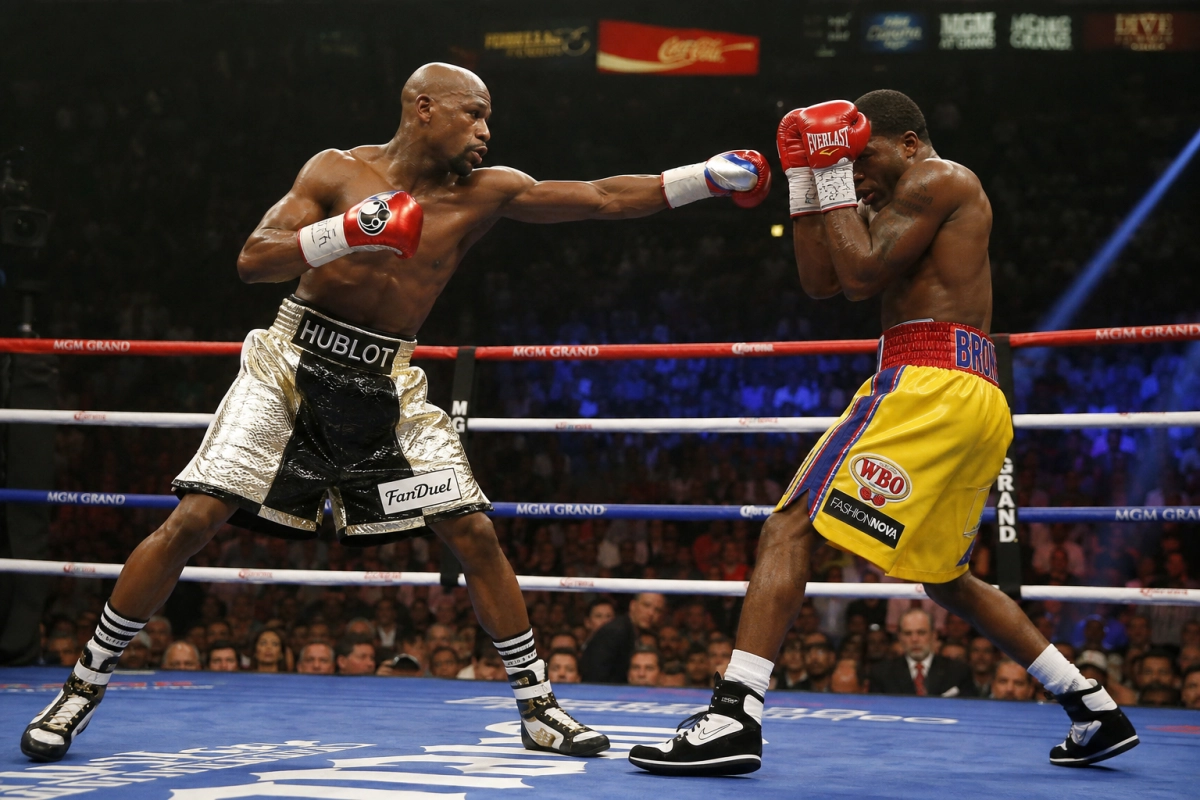
Against pressure fighters like Ricky Hatton, Mayweather used subtle footwork to keep the fight on the outside just long enough to frustrate forward momentum, then stepped inside at moments of his own choosing to land short, sharp counters. Against more technical opponents, he chose angles over straight-line movement, using the ring’s geometry to his advantage.
The Role of the Jab in Setting Distance
The jab served Mayweather as a measuring tool as much as an offensive weapon. He used it to gauge reaction time, test an opponent’s guard, and establish where the safe and dangerous zones existed at any given distance. Each exchange told him something about how his opponent moved, breathed, and responded under pressure.
This intelligence gathering happened continuously, which explains why Mayweather often looked more dominant as rounds progressed. His adjustments were not guesswork — they were the product of precise, real-time data collected through controlled engagement from the opening bell onward.
Pace Manipulation: How Mayweather Controlled the Heartbeat of Every Fight
If range control was Mayweather’s spatial weapon, pace manipulation was his temporal one. The rhythm of a boxing match has an enormous psychological and physical impact on both fighters. Most world-class boxers enter the ring with a preferred tempo their entire game plan is built around. Mayweather’s singular gift was identifying that tempo and systematically denying it.
Against explosive, high-volume punchers, he slowed the fight down. Against methodical opponents, he introduced unpredictable bursts of speed that disrupted their timing and forced reactive decisions. He shifted constantly, and the shifting itself was part of the strategy — because an opponent who cannot predict when danger is coming cannot properly prepare for it.
The quiet rounds were not wasted rounds. They were moments when he conserved energy while constructing a psychological framework designed to make opponents second-guess their own instincts. By the time a fighter adjusted to one tempo, Mayweather had already moved to another.
The Clinch as a Pace-Breaking Tool
One of the most underappreciated elements of Mayweather’s pace control was his use of the clinch. Used strategically, it interrupts an opponent’s offensive rhythm at the moment of greatest momentum, provides brief physical recovery, and forces a complete reset of the engagement.
Mayweather timed his clinches with remarkable precision — closing the distance at the exact moment an opponent committed to a combination, smothering the follow-through before it could land cleanly. Against Canelo Álvarez, whose power derived partly from combination fluency and physical strength, these well-timed interruptions prevented him from ever finding a sustained rhythm. The fight never felt like it belonged to Álvarez, not because Mayweather was faster or stronger, but because the tempo Álvarez needed was never permitted to exist long enough to matter.
Ring Space as Architecture: How Mayweather Designed the Geography of Every Fight
Experienced fighters describe certain opponents as making the ring feel smaller or larger depending on how they move through it. Mayweather was perhaps the most sophisticated practitioner alive at redesigning that space in real time.
He dictated where in the ring each exchange took place — controlling not just his own movement but subtly channeling his opponent’s as well, creating invisible corridors that guided aggressive fighters into situations where their aggression worked against them. His footwork was never decorative. Every lateral step, every pivot off the ropes served a specific tactical function. When cornered, he used upper body movement and sharp pivots to exit without panicking, transforming a momentarily defensive position into an offensive opportunity.
Cutting Off the Ring Without Chasing
What separated Mayweather from merely elusive fighters was that his movement was always purposeful rather than purely evasive. He steered the fight toward positions of his choosing — a fundamentally more sophisticated application of footwork than simple escape.
- He used diagonal footwork to prevent straight-line attacks while repositioning himself at better angles.
- He ceded the center of the ring temporarily to draw opponents forward, then reclaimed it on his own terms.
- He angled off after combinations rather than retreating straight back, preventing opponents from repeating attacks on the same line.
- He used the full circumference of the ring, forcing opponents to rotate and reset constantly rather than build pressure from a fixed direction.
The cumulative effect across twelve rounds was exhaustion — not just physical tiredness, but the deeper cognitive fatigue that comes from continuously failing to land the shot that seemed right there. Opponents did not simply lose on the scorecards. They lost in their own minds several rounds before the final bell.
Why No Style Ever Had an Answer: The Unified Theory of Mayweather’s Dominance
What made Mayweather’s tactical system so difficult to solve was not any single element in isolation. When range control, pace manipulation, and ring space management operated simultaneously and in constant conversation with each other, the result was a closed system with no reliable point of entry for any stylistic archetype his opponents brought into the ring.
Southpaws presented a different geometric puzzle, and he solved it. Power punchers found the distance perpetually wrong. Slick counterpunchers discovered that Mayweather had already occupied the tactical ground they intended to stand on. Trainers who studied his fights closely noted that his adjustments were not scripted solutions carried in from the gym — they were improvised applications of deeply internalized principles. The principles remained constant; everything else was fluid.
There is a tendency, when discussing historically great athletes, to attribute success to natural gifts and leave the analysis there. With Mayweather, that approach fails completely. The gifts were real — his reflexes, his hand speed, his spatial instincts. But the architecture built on top of those gifts was the product of decades of conscious, deliberate construction, passed down through a lineage of boxing knowledge and refined through thousands of rounds of competitive application.
What he demonstrated across five weight classes and twenty-one years of professional competition was that boxing, at its highest level, is not primarily a physical contest. It is a contest of problem-solving under extreme pressure, conducted at speed, with consequences for every error. By that measure, Floyd Mayweather did not merely win fights. He rendered the very concept of opposition almost theoretical — not through dominance of force, but through dominance of thought. That is the legacy that 50-0 actually represents, and it is one that will outlast every record it took to build it.