
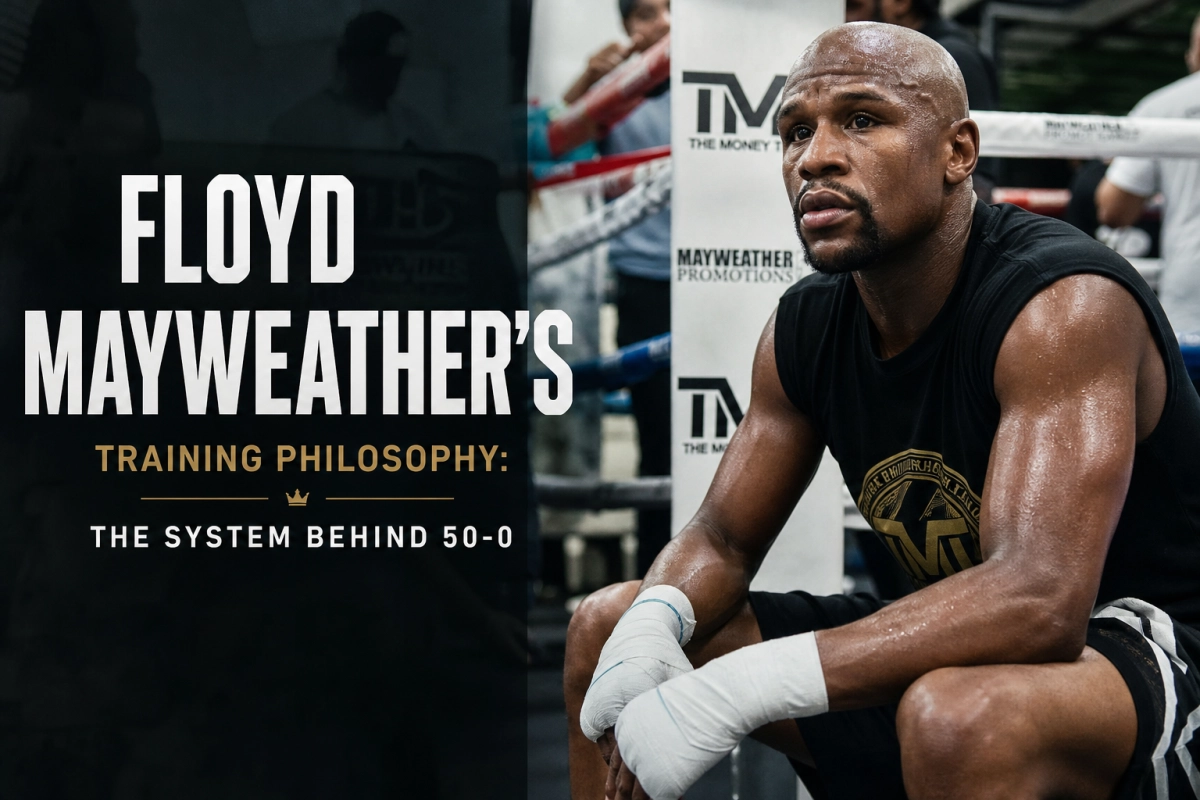
Floyd Mayweather’s Training Philosophy: The System Behind 50-0
How Floyd Mayweather Built a Career That Defied Every Expectation
Few athletes in combat sports history have demonstrated the sustained excellence that Floyd Joy Mayweather achieved across more than two decades of professional boxing. Finishing with a perfect 50-0 record and championships spanning five weight classes — from super featherweight to light middleweight — Mayweather didn’t just win fights. He controlled them, systematically dismantling opponents who were often bigger, younger, or considered more powerful. That consistency doesn’t come from natural talent alone. It comes from a training philosophy built with extraordinary precision.
His approach combined structured physical conditioning, obsessive technical refinement, and a mental framework that treated every opponent as a serious threat regardless of public perception. The result was a fighter who rarely looked rushed, hurt, or outworked — a remarkable achievement at the elite level of the sport.
The Mayweather Boxing Club and the Culture of Hard Work
Mayweather trained primarily out of the Mayweather Boxing Club in Las Vegas, a gym that became as much a part of his identity as his defensive brilliance. Sparring sessions were long, competitive, and closely observed. He regularly brought in multiple sparring partners — often selected to mimic his upcoming opponent’s style — so that by fight night, very little in the ring felt unfamiliar.
His training camp structure was built around repetition and specificity. Every drill had a purpose tied directly to the demands of his next bout. Pad work with trainer and uncle Roger Mayweather was crafted to sharpen his signature shoulder roll defense, precise counterpunching, and distance control through footwork. These skills were drilled so thoroughly that they became automatic responses under pressure.
Night Running as a Foundation of His Conditioning
One of the most well-documented elements of Mayweather’s routine was his late-night roadwork. Running after midnight became a hallmark of his preparation and reflected a broader philosophy: train when others rest, building a physical and psychological edge through discipline that extended beyond the gym.
Cardiovascular conditioning was central to everything he did. In a sport where fatigue can collapse even the most technically gifted fighter in the later rounds, his stamina was exceptional. He rarely slowed visibly between rounds, maintaining the same defensive precision in round twelve as in round one. That consistency was earned through thousands of miles logged in the dark.
Diet, Recovery, and the Details That Separate Good from Great
Mayweather treated nutrition as an extension of his preparation. Managing weight across multiple divisions over a long career required disciplined attention to eating, hydration, and body composition. He worked with nutritional support to ensure that weight cuts didn’t compromise his energy or reflexes on fight night.
Recovery played an equally meaningful role. Rest and careful management between hard training sessions allowed him to sustain camp intensity without breaking down physically. Mayweather’s camps were structured to ensure he arrived at fight week fresh rather than carrying accumulated fatigue.
The Mental Architecture Behind an Undefeated Mindset
Physical conditioning and technical skill alone cannot account for what Mayweather accomplished. At the elite level, the margin between winning and losing often exists entirely in the mind. His mental preparation began long before fight week. Throughout camp, he studied opponents methodically — watching film, identifying tendencies, and constructing a clear picture of how each fight would unfold. By the time he walked to the ring, he had already visualized countless versions of the contest. Nothing felt entirely new.
That cognitive readiness translated directly into his ring behavior. When opponents landed clean shots — which did happen — he processed the moment without panic, resetting emotionally and recalibrating immediately. Composure at that level is a trained skill, not a personality trait, and Mayweather treated it accordingly.
Confidence as a Tactical Weapon
Much has been made of Mayweather’s public persona — the self-promotion, the declarations of greatness, the deliberate theatrics. What often gets lost is how strategically his confidence functioned inside the competitive environment. His outward bravado reflected an inner certainty that proved remarkably stable across decades and opponents. He entered fights expecting to win, which is a fundamentally different psychological state than hoping to win. That distinction shaped every decision he made from the opening bell.
Adapting Across Weight Classes Without Losing Identity
One of the most underappreciated dimensions of Mayweather’s career is what it required to remain elite while moving through five weight divisions over more than twenty years. Fighters who attempt this range frequently find their style compromised as they encounter opponents whose physical attributes neutralize strengths that worked at lower divisions.
Mayweather navigated this by building his game around principles that scaled naturally across weight classes. His shoulder roll defense worked whether the man throwing punches weighed 130 pounds or 154. His footwork and distance management functioned independent of opponent size. His counterpunching — reliant on timing and precision rather than raw power — remained effective even against significantly bigger fighters.
The Role of Roger Mayweather in Technical Evolution
No account of Mayweather’s preparation is complete without examining his uncle Roger’s role in shaping his technical development. Roger Mayweather, himself a former two-division world champion, served as head trainer through much of Floyd’s most celebrated era. Their relationship was deeply iterative. Roger understood Floyd’s physical capabilities intimately and identified subtle inefficiencies in movement or defense that outside observers would never detect.
What distinguished their working relationship was the level of granular refinement it produced. Most elite fighters work on broad skills during camp. Mayweather and Roger worked on fractions — the precise angle of a shoulder, the exact moment to initiate a step back, the timing of a catch that turned a potential knockdown into a clean defensive exchange. That attention to detail is what separates a fighter who wins most of the time from one who wins all of the time.
What the 50-0 Record Actually Represents
When the names on that ledger are examined honestly — Oscar De La Hoya, Shane Mosley, Miguel Cotto, Canelo Álvarez, Manny Pacquiao, Marcos Maidana — what emerges is not a curated illusion of invincibility. It is the result of a preparation system applied with uncommon consistency against genuinely elite opposition across an extraordinarily long career.
The record is the outcome. The training philosophy is the explanation. Every element of Mayweather’s approach — the late-night running, the opponent-specific sparring, the obsessive technical refinement, the nutritional discipline, the psychological conditioning, the adaptability across weight classes — functioned as part of a single integrated system designed to eliminate uncertainty. Not to reduce the chances of losing. To eliminate them.
Mayweather did not simply avoid being beaten. He constructed conditions in which being beaten became structurally improbable. The opponents changed. The weight classes changed. The decades changed. The system did not.
In a sport that has always romanticized toughness over intelligence, Mayweather’s greatest contribution may be the demonstration that the two are not in competition. Physical gifts without strategic direction produce good fighters. Strategic direction applied with relentless discipline, over the course of an entire career, produces something rarer: a fighter who never lost.
That is what fifty-and-zero actually represents. Not luck, not avoidance, not myth — but the cumulative return on an investment in preparation that began long before any camera was ever pointed at it.
