Floyd Mayweather’s Defensive Mastery: A Technical Breakdown of the Shoulder Roll and Beyond
The Art of Not Getting Hit: How Mayweather Built an Untouchable Defense
Across a professional career spanning more than two decades, Floyd Mayweather compiled a perfect 50-0 record against some of the most dangerous fighters in the sport. What made that achievement remarkable was not simply the wins, but how they were secured. He was never stopped, never knocked down. Despite facing knockout artists, speedsters, and technical masters, he walked away from every contest largely unscathed. That durability is the product of a defensive system so refined that many analysts consider it the most complete ever seen in professional boxing.
His approach combined several distinct skills — the shoulder roll, precise head movement, calculated footwork, and ring generalship — all working together to neutralize opponents before they could build any real offensive rhythm. Taken as a whole, they represent a masterclass in the tactical side of boxing that is rarely discussed with the depth it deserves.
The Shoulder Roll: Defense as an Offensive Weapon
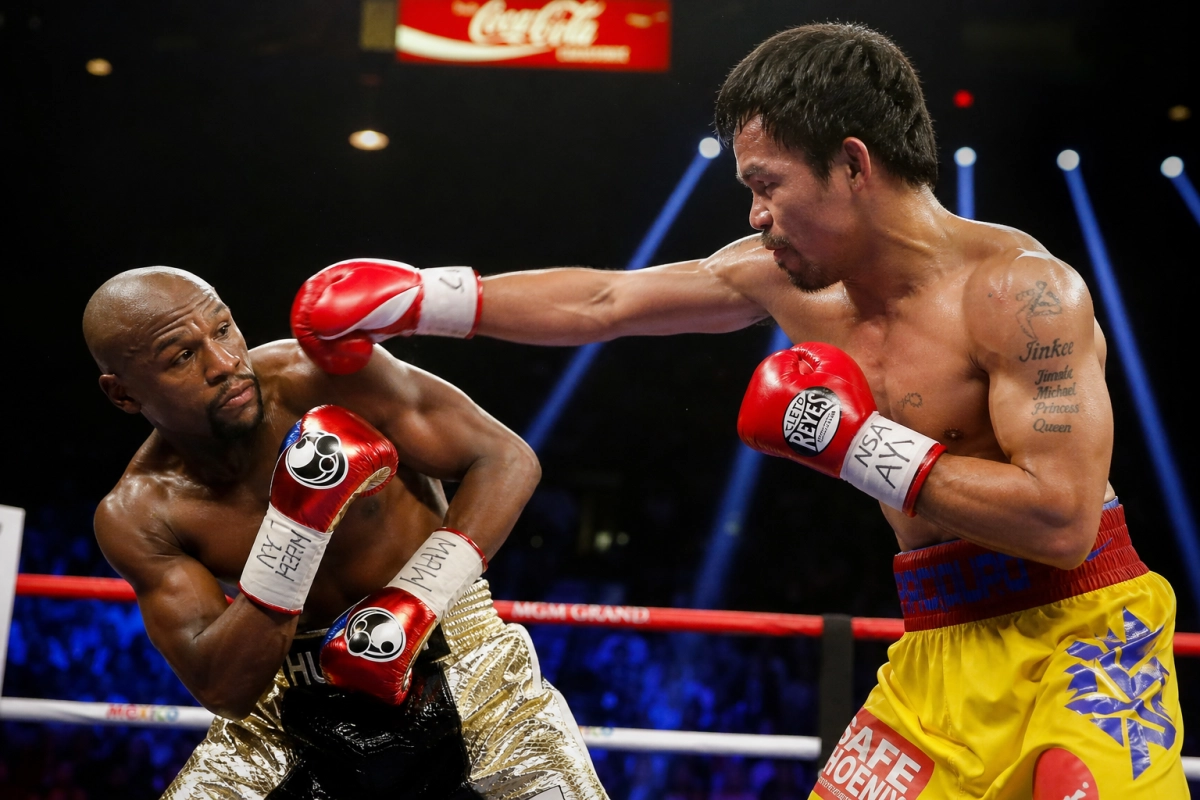
The shoulder roll, sometimes called the Philly Shell, is a technique in which a boxer uses the lead shoulder to deflect incoming punches rather than blocking with the glove or slipping entirely. In the Philly Shell stance, the lead arm drops lower than in a conventional guard, resting across the midsection, while the rear hand sits high near the chin. This leaves the lead shoulder elevated and angled forward, creating a natural ramp that redirects straight punches away from the head.
Mayweather did not invent this guard — its roots trace back through Roger Mayweather and fighters like Pernell Whitaker — but he elevated it to a precision few have matched. What separated his execution was timing. He read punches as they were being loaded, moved his upper body fractionally in the right direction, and allowed the shoulder to meet the shot at just the right angle to rob it of power. Clean, hard punches frequently glanced away harmlessly, leaving opponents frustrated and exposed.
Crucially, the shoulder roll also serves as a launching platform for counters. When a right hand rolls off Mayweather’s left shoulder, his rear hand is already cocked and ready. The counter right over the top became one of his most reliable scoring punches precisely because the defensive motion set it up naturally. This is what separates elite defensive technique from passive defense: converting protection directly into offense without an additional preparation step.
Why the Philly Shell Works Against Power Punchers
Against heavy-handed opponents, the value of the shoulder roll becomes even clearer. A punch deflected off a rolling shoulder loses much of its trajectory and energy before making contact. Opponents including Shane Mosley, Marcos Maidana, and Canelo Álvarez all arrived with genuine knockout power, yet none landed with the sustained clean force needed to seriously trouble him.
The technique is not without risk. Dropping the lead arm creates a potential opening on the body and left side of the head if the timing is off. Mayweather managed this through constant positional awareness and the ability to adjust mid-exchange — qualities that speak to a broader defensive intelligence well beyond any single technique.
Head Movement and the Science of Making Punches Miss
If the shoulder roll is Mayweather’s most recognizable tool, his head movement is arguably the more foundational one. A fighter who relies solely on deflection will eventually encounter a punch that beats the timing. Head movement prevents that by ensuring the target is rarely where the opponent expects it. Watching him work through the middle rounds of a fight reveals a constant, almost imperceptible rhythm of shifting and adjusting that makes clean contact extraordinarily difficult.
His head movement was not dramatic. There were no wild, exaggerated lunges to the side. Instead, movements were compact and economical — a slight lean back off the rear foot, a fractional tilt outside a jab, a controlled pivot before a combination could develop. This economy meant he was never out of position or off balance, and opponents who expected to draw him into an overcommitted slip found themselves hitting air and absorbing a right hand on the way back.
Distance Management and Disrupting Rhythm
Closely tied to head movement is distance management, where Mayweather displayed a spatial awareness that bordered on the remarkable. He operated just outside punching range — close enough to threaten with his own offense, far enough that most incoming shots arrived slightly short or at reduced velocity. He manipulated this distance actively, moving toward opponents between punches and retreating the instant an attack was loading.
When a punch lands at the very end of its range, it carries a fraction of the force it would at optimal distance. Mayweather consistently ensured opponents were stretching for him, meaning even shots that landed often did less structural damage than they might have against a stationary target. His footwork made this sustainable — always repositioning in small increments, rarely retreating in straight lines, instead using lateral movement and pivots to reset the geometry of the fight on his own terms.
Ring Generalship: Controlling the Fight Without Throwing a Punch
Ring generalship refers to a fighter’s ability to control space, dictate the terms of engagement, and impose a structure that favors their strengths while exposing the opponent’s weaknesses. Mayweather practiced it at a level that drew comparisons to chess players — descriptions that sound hyperbolic until you watch him dismantle a pressure fighter without throwing an unusually high punch volume.
His clearest expression of ring generalship was neutralizing fighters whose primary advantage was forward pressure. Fighters like Miguel Cotto and Canelo Álvarez built their success on cutting off the ring and overwhelming opponents once they ran out of space. Against Mayweather, that formula consistently broke down because he refused to cooperate with the spatial logic those fighters depended on. He used the ring’s full dimensions, changed angles before traps could close, and escaped corners through composed, premeditated pivots that left charging opponents punching through empty space.
The Psychological Dimension
There was also a psychological dimension to his ring generalship that compounded its physical effectiveness. When an opponent throws hard punches for multiple rounds without landing cleanly, frustration accumulates and judgment erodes. Fighters begin to overcommit, load up for single big shots, and abandon the disciplined combinations that made them dangerous. Mayweather understood and deliberately cultivated this dynamic. His defense was not only a means of avoiding damage — it was a mechanism for breaking confidence and extracting tactical errors he could then punish.
By the middle rounds of most contests, opponents who had arrived with sophisticated game plans were improvising out of desperation. At that point, the fight had already been won at a strategic level.
The Legacy of an Untouched Blueprint
What Mayweather built across 21 years was not simply a record. It was a complete defensive philosophy, assembled from inherited knowledge, relentless repetition, and a clinical desire to win on his own terms. The shoulder roll, the compact head movement, the spatial control, the psychological warfare conducted through sheer inaccessibility — none of these existed in isolation. They formed an interconnected system in which each component reinforced the others, and the whole became genuinely greater than the sum of its parts.
In a sport that rewards aggression, Mayweather consistently demonstrated that the highest form of boxing intelligence is not about how hard you can hit, but how completely you can control the conditions under which you are hit at all. That principle — defense as active dominance rather than passive survival — runs through every significant performance he delivered.
Several fighters in the current generation have incorporated elements of the Philly Shell into their repertoires, with varying degrees of success. What those attempts reveal, more than anything, is how rare the full package actually is. The individual components are teachable. The integration of all of them, operating simultaneously at championship level against elite opposition, belongs to a very short list of achievements in the sport’s history.
Mayweather will remain a polarizing figure for reasons extending well beyond the technical. But the defensive architecture he constructed and sustained — without a single knockdown across five weight classes and 50 professional fights — represents something boxing may not see replicated in full for a very long time. It was a system built to make the most dangerous men in the world feel helpless, and by every measurable standard, it worked exactly as designed.