How the Mayweather vs McGregor Fight Was Built Into a Billion-Dollar Business
When Sport Became a Financial Spectacle: The Business Behind Mayweather vs McGregor
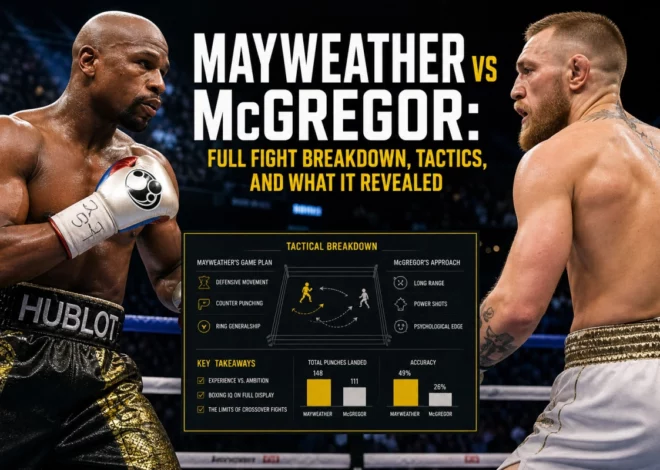
Few sporting events have blurred the line between athletic competition and commercial theatre as deliberately as Mayweather vs McGregor. When Floyd Mayweather Jr., an undefeated champion with a 49–0 record, agreed to face Conor McGregor, a UFC star with no professional boxing experience, purists questioned the matchup’s legitimacy. Promoters and executives, however, saw something far simpler: an extraordinary opportunity to generate revenue on a scale that few fights had ever achieved.
This was not simply a fight that was booked and sold. It was an event engineered, piece by piece, to extract maximum value from every possible platform and audience.
Contract Negotiations: Aligning Two Worlds With Very Different Rules
One of the most significant obstacles was the structural difference between the two athletes’ professional homes. Mayweather operated under boxing’s regulatory framework, while McGregor was under exclusive contract with the UFC, meaning any outside deal required the organisation’s approval and financial participation. Bridging those two worlds took months of negotiation involving multiple parties, legal teams, and competing financial interests.
The UFC negotiated a meaningful share of the event’s proceeds in exchange for releasing McGregor to compete. The framework that emerged allowed the fight to proceed under boxing rules, at a contracted weight of 154 pounds, with both camps retaining control over separate elements of the revenue split.
Mayweather Promotions worked alongside Showtime Sports, which held US broadcast rights. Showtime had invested heavily in Mayweather’s later career, and its proven pay-per-view infrastructure gave the fight immediate commercial credibility before a single press conference had been announced.
How the Revenue Model Was Structured
From the earliest stages, the financial architecture was built around pay-per-view as the primary driver. McGregor’s fanbase was younger and accustomed to UFC events, while Mayweather’s audience included seasoned boxing followers. The goal was to capture both demographics simultaneously — then reach further into casual fans who might tune in purely for the spectacle.
- Domestic pay-per-view sales through Showtime and AT&T were priced significantly above standard boxing cards.
- International broadcast rights were sold separately across dozens of territories.
- Gate receipts from the T-Mobile Arena in Las Vegas added a further substantial sum, with ringside seats commanding extraordinary prices.
- Closed-circuit viewing rights for bars, hotels, and entertainment venues formed another distinct revenue stream.
The premium pricing was itself a statement of intent — positioning the event not as a typical boxing card but as a cultural moment people would feel compelled to pay for simply to be part of the conversation.
The World Tour: Turning Hostility Into a Promotional Weapon
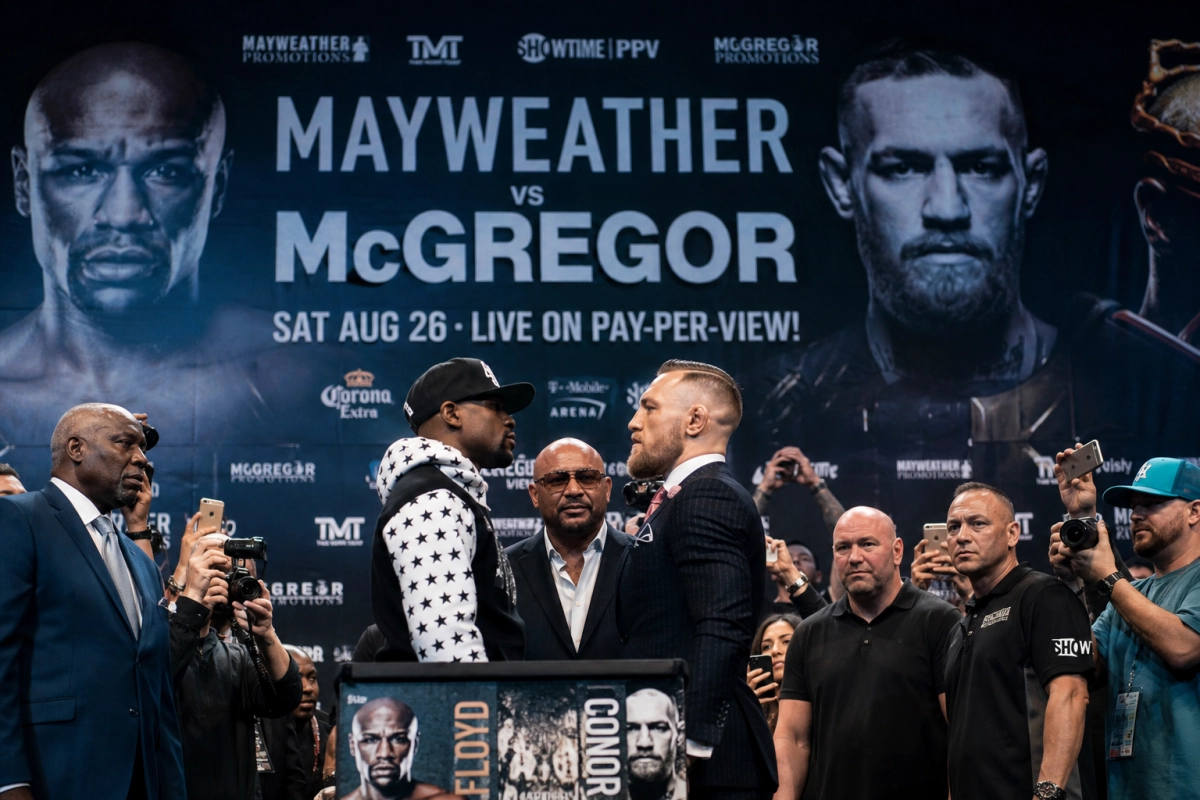
When the promotional tour launched in July 2017, its four-city run — Los Angeles, Toronto, New York, and London — was designed not to inform the public but to provoke them into caring. Every element was calibrated to generate footage that would travel across social media and dominate sports coverage for days after each stop.
Mayweather arrived as the composed, experienced professional. McGregor arrived as something harder to categorise — part showman, part provocateur, entirely unbothered by convention. The contrast between controlled disdain and verbal aggression became the story itself, transforming what might have been a routine press junket into appointment viewing.
The London stop was particularly significant commercially. McGregor’s following across the UK and Ireland turned that event into something approaching a homecoming rally, reinforcing broadcasters’ confidence in their territorial deals. Every roaring crowd was doing marketing work that no advertising spend could have replicated.
Social Media as Infrastructure, Not Afterthought
What separated this campaign from its predecessors was how thoroughly digital distribution was treated as a structural priority. Both fighters’ social media accounts functioned as independent broadcast channels throughout the build-up, with clips edited and pushed within hours of each event in platform-specific formats.
McGregor’s team was particularly sophisticated. His social media presence had already demonstrated during UFC campaigns that organic reach could substitute for expensive traditional media. Behind-the-scenes footage, training camp glimpses, and carefully timed exchanges kept the conversation active across weeks that would otherwise have gone quiet.
- Both fighters addressed each other directly online, bypassing traditional media gatekeepers and creating news rather than simply responding to it.
- Press tour clips accumulated tens of millions of views, providing measurable evidence of demand that broadcasters could present to buyers.
- Merchandise drops and branded content partnerships were timed to coincide with peak social media traffic.
How Both Camps Engineered Their Financial Positions
Beyond shared revenue, each side had constructed individual arrangements extending well past fight night. Mayweather, who understood the economics of combat sports from both sides of the table, secured a guaranteed minimum alongside backend participation in overall event revenue. His company’s involvement meant he participated in the commercial upside not just as a fighter but as a promotional entity — a distinction that significantly raised his earning ceiling.
McGregor’s earnings were shaped partly by the UFC’s retained portion, but the fight still represented the largest single payday of his career. His team used the platform to advance his personal brand in ways that would generate income long after the final bell — sponsorship arrangements, licensing deals, and the broader elevation of his profile in the American mainstream market.
Both camps recognised that the fight itself was only one component of the financial opportunity. The weeks of promotion, the media presence, the cultural conversation — all of it had monetary value that could be captured through multiple channels simultaneously.
The Blueprint That Outlasted the Fight Itself
When Mayweather stopped McGregor in the tenth round to move to 50–0, the sporting result was almost secondary to what had already been accomplished commercially. The fight generated approximately 4.3 million domestic pay-per-view buys and produced purses ranking among the largest in combat sports history. Mayweather’s reported earnings crossed $300 million when all revenue streams were accounted for. McGregor, despite losing, walked away with a figure widely reported in excess of $100 million.
What Mayweather vs McGregor demonstrated, with uncomfortable clarity for traditional sports executives, was that the architecture of demand had fundamentally shifted. A fight did not need historical significance or deep sporting rivalry to command premium pricing. It needed a compelling conflict, two figures with large and distinct audiences, a promotional apparatus willing to embrace spectacle, and a digital distribution layer capable of turning every provocative moment into organic marketing.
Mayweather understood that his undefeated record had one final act of maximum leverage left in it — and he exercised it on his own terms, through his own promotional company, with a share of the commercial upside a conventional fighter’s contract would never have provided. McGregor understood that crossing into boxing, regardless of outcome, would establish him as a figure who transcended any single sport, with the American mainstream market now fully open to him.
Not everyone was comfortable with what the fight represented. Purists argued, reasonably, that rewarding novelty over merit undermined the sport’s integrity. Those objections were legitimate. They were also largely irrelevant to the commercial machine that had already been built and paid for. Sport has always contained a tension between integrity and entertainment. Mayweather vs McGregor did not create that tension — it simply monetised it more effectively than almost any event before it.
That machinery — built from contract architecture, broadcast partnerships, disciplined pricing, social media infrastructure, and a theatrical willingness to treat hostility as entertainment — is ultimately what made Mayweather vs McGregor possible, profitable, and permanently instructive for everyone watching from the business side of sport.