How Professional Boxing Judging Works: Scoring Criteria, Process, and Controversies
Why Boxing Decisions Remain One of Sport’s Most Contested Outcomes
Few moments in sport generate more immediate debate than a boxing judge’s scorecard. The fight ends, the announcer reads the numbers, and within seconds social media erupts, corners argue, and fans question what they just watched. Disputed decisions have followed the sport for over a century, yet in modern boxing the conversation around judging has never been louder. Understanding how judges score a fight — and why trained observers sometimes reach wildly different conclusions — is essential for anyone who follows the sport seriously.
Professional boxing uses the ten-point must system, the foundation of scoring across every major sanctioning body worldwide. The winner of each round receives ten points; the opponent typically receives nine. A knockdown generally costs the losing fighter an additional point. At the end of the bout, three ringside judges submit their scorecards, and the totals determine whether the result is a unanimous, split, or majority decision.
What makes this straightforward framework genuinely complicated is the subjective layer sitting on top of it. Judges are not simply counting punches. They are assessing quality, effectiveness, and competitive control in real time, without the benefit of replay or pause.
The Four Criteria Judges Use to Score Each Round
Most major sanctioning bodies instruct judges to evaluate each round based on four interconnected criteria. In practice, the first carries the most influence.
- Clean punching: Punches that land flush with power and accuracy, without being blocked or deflected. This is the primary scoring factor.
- Effective aggression: Forward pressure that produces meaningful offensive output. Walking toward an opponent without landing does not meet the standard.
- Defense: A fighter’s ability to avoid, slip, or block incoming shots. Strong defensive work can shift a round even when a fighter throws less.
- Ring generalship: Tactical control of space, distance, and tempo. A boxer who dictates where the fight takes place and neutralizes an opponent’s strengths demonstrates generalship even without being the busier fighter.
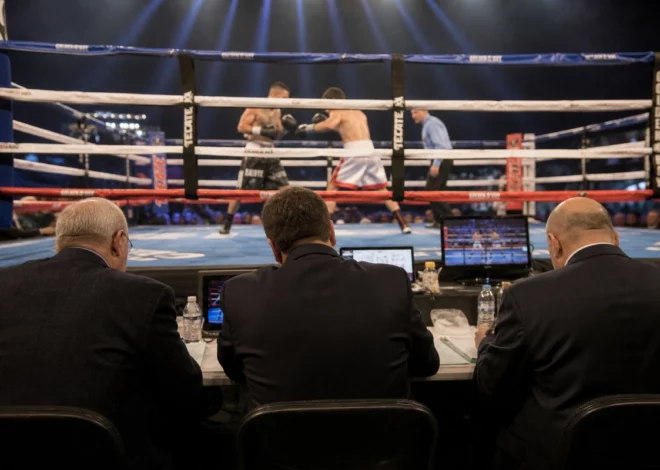
Judges weigh these criteria collectively for each round and cannot revisit earlier rounds once scored. They have no access to CompuBox data or replays — every assessment is made live, from a single ringside angle, which creates the conditions for honest disagreement among equally qualified observers.
This framework explains many decisions that initially seem baffling. A fighter who lands fewer total punches but connects with harder, cleaner shots can legitimately outscore a busier opponent. A slick defensive boxer who controls distance may win rounds without delivering significant punishment. Both outcomes are consistent with the rules — which is precisely why two judges can watch the same three minutes and score it differently without either being obviously wrong.
How Punch Statistics Fit Into the Picture
CompuBox records total punches thrown and landed, broken down by jabs and power shots. Viewers often treat these numbers as an objective scoreboard, but judges in the arena have no access to this data. Their scoring is purely observational.
This disconnect matters. CompuBox counts any punch that appears to make contact, regardless of whether it was cleanly absorbed or partially blocked. A judge positioned at ringside may see clearly that a combination was largely deflected by the defender’s guard, even if the tracking system registers those punches as landed. The judge’s live read may be more accurate than the statistic — or it may not be. Both possibilities exist, which is why punch statistics inform debate without settling it.
Where the System Breaks Down
The framework functions reasonably well when one fighter is the clear aggressor and clean punching is distributed unevenly enough to signal a winner. Problems multiply when the fight is close, when neither fighter dominates any single criterion, or when judges must weigh competing forms of effectiveness in real time. These are precisely the conditions that produce decisions that linger for years in boxing conversation.
One persistent structural issue is the home fighter advantage. Research examining professional results over decades has found that fighters competing in their home country or city win decisions at rates exceeding what punch statistics and round-by-round analysis would predict. Whether this reflects deliberate bias, unconscious familiarity, or crowd noise subtly shaping a judge’s live perception of dominance is difficult to isolate — but the concern carries enough credibility that major promoters actively factor venue into their assessment of judging risk when planning championship fights.
A second fault line involves how judges score championship rounds relative to the opening third of a fight. There is a longstanding debate about whether judges unconsciously anchor late-round scoring to the fight’s early narrative rather than evaluating each round as a clean slate. A fighter who struggled early but mounted a strong finish may have won more rounds in the championship stretch than the scorecards reflect, because judges have already formed a working impression that is difficult to fully override. This cognitive anchoring effect appears in most domains requiring rapid sequential assessment, but its consequences in a sport decided by three scorecards are particularly stark.
The Role of Judge Selection and Accountability
Boxing does not employ a centralized pool of officials governed by a single independent authority. Judging assignments are typically controlled by state or regional athletic commissions, which vary considerably in licensing standards, training requirements, and ongoing performance evaluation. A judge working a world championship bout in one jurisdiction may have passed through a genuinely demanding certification process; a judge officiating an equivalent fight elsewhere may have followed a considerably less demanding path to the same ringside seat.
Accountability after the fact is similarly inconsistent. When a decision draws widespread criticism, the response from governing bodies typically ranges from a brief public statement to no comment at all. Rarely are judges subjected to formal post-fight review that results in documented consequences affecting future assignments. The sport has not developed a transparent, sport-wide mechanism for evaluating judge performance the way professional football officiating departments review game film and grade officials weekly.
Why Technology Hasn’t Solved the Problem
The natural question is whether technology could replace human observers. Pilot programs using algorithmic assessment have been trialed in amateur competition with instructive but inconclusive results. The core difficulty is that no automated system has yet demonstrated the ability to reliably distinguish a clean punch from one that was partially blocked, assess genuine rocking impact versus a shot that landed without meaningful effect, or evaluate the tactical significance of ring generalship the way an experienced human observer does intuitively. Punch-tracking technology counts contact events. It does not read fights. Until that gap is substantially narrowed, technology functions as a useful supplement rather than a credible replacement — which means the sport remains dependent on the quality and integrity of the people in those three ringside chairs.
What Better Judging Actually Requires
Improvement, where it has occurred, has come from specific practical changes rather than broad structural overhauls. Jurisdictions that have introduced mandatory continuing education for licensed judges, required documented scoring of preliminary bouts before officials advance to championship assignments, and implemented post-fight scorecard review have produced measurably fewer decisions that diverge sharply from punch statistics and round-by-round consensus. These are not revolutionary reforms — they are professional standards that most high-stakes judging environments take for granted, applied to a sport that has historically been reluctant to impose them.
Transparency is perhaps the most undervalued tool available to boxing’s governing bodies. When judges are required to submit round-by-round scorecards for public review, when post-fight analysis of scoring patterns becomes part of the record, and when assignments are visibly tied to performance rather than relationships, the culture around judging changes. Officials who know their work is being examined tend to approach that work differently. This is not a radical proposition — it is simply the application of accountability to a role that has operated largely without it.
None of this eliminates the fundamental subjectivity at the heart of scoring a boxing match. Two experienced, honest, and well-trained judges will sometimes watch the same round and reach genuinely different conclusions, because the criteria capture competing dimensions of performance rather than a single measurable outcome. That ambiguity is partly what makes the sport compelling.
What boxing can reasonably aspire to is a judging environment where controversial decisions reflect genuine interpretive disagreement rather than inadequate preparation, proximity to powerful promotional interests, or bias that goes unchallenged because no formal mechanism exists to identify it. That distinction — between a close call made in good faith and a decision that should never have gone the way it did — is the line the sport needs to draw more clearly, and enforce more consistently, if it wants the authority of its scorecards to carry the weight that championship outcomes demand.
Until that standard becomes the rule rather than the exception, the moment the announcer reads the scorecards will continue to feel, for many watching, like the beginning of an argument rather than the resolution of one.

Related Posts
How Professional Boxing Judging Works: Scoring Criteria, Process, and Controversies
Mayweather vs McGregor Tactical Breakdown: What McGregor Got Right and Why It Fell Apart