Mayweather vs McGregor Tactical Breakdown: What McGregor Got Right and Why It Fell Apart
The Night MMA Met the Pinnacle of Professional Boxing
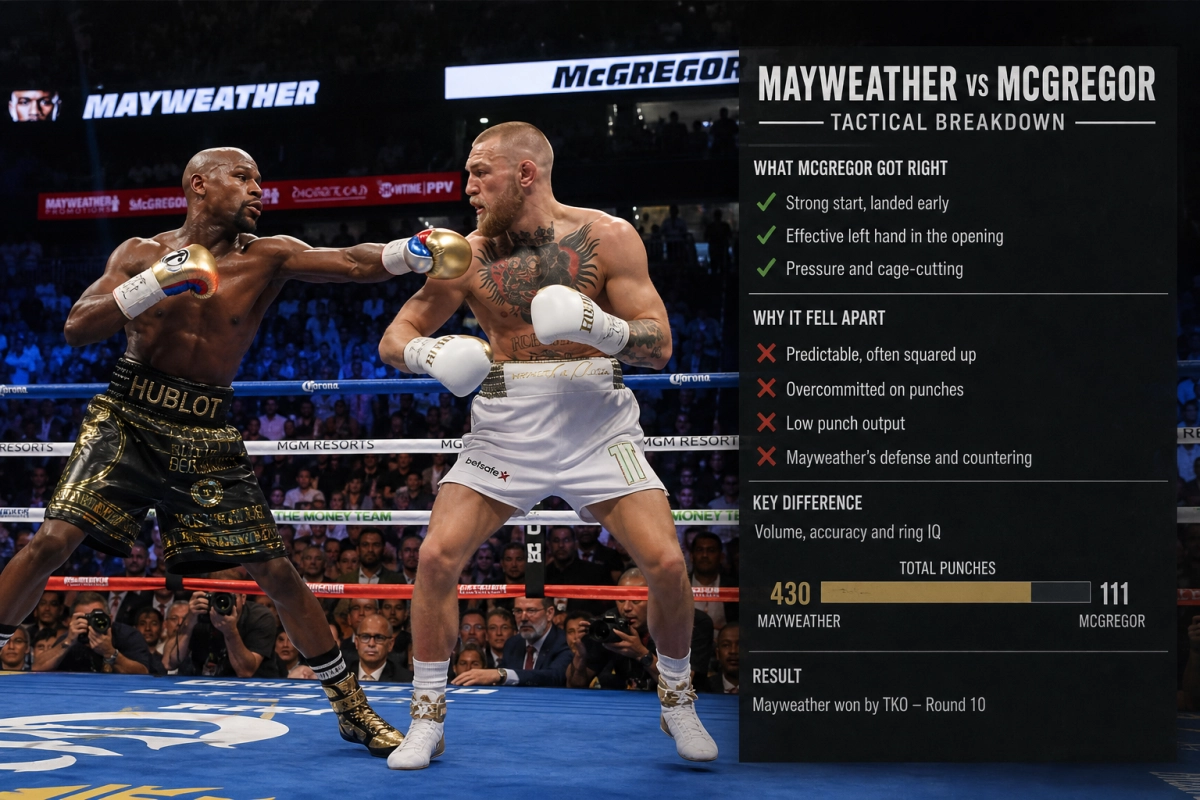
When Mayweather vs McGregor was confirmed for August 26, 2017, at the T-Mobile Arena in Las Vegas, the boxing world responded with curiosity and skepticism. Floyd Mayweather Jr. was a retired, unbeaten boxer with a 49-0 record, widely regarded as one of the most technically complete defensive fighters in the sport’s history. Conor McGregor was the UFC’s most marketable star — a gifted MMA striker with no professional boxing record. On paper, the outcome seemed predetermined. What made the fight genuinely instructive was not the final result but how McGregor performed in the early rounds, and how quickly his approach unraveled once Mayweather settled into his rhythm.
McGregor’s Early-Round Strategy and Why It Briefly Worked
McGregor entered as a southpaw — leading with the right hand and right foot. This creates specific geometrical problems for orthodox fighters like Mayweather, since opposite stances shift angles in ways that can disrupt familiar defensive patterns. McGregor understood this and used it deliberately.
In rounds one through three, he attacked Mayweather’s body and pushed forward with controlled aggression. His left hand — the power hand from the southpaw stance — landed frequently enough to win those rounds on several scorecards. He kept combinations short, avoided overcommitting, and used his size to apply pressure along the ropes.
The Role of Unorthodox Angles
MMA strikers typically throw with wider arcs and more lateral head movement than classical boxing mechanics allow, designed to account for kicks, takedowns, and clinch transitions. Against Mayweather, those wider angles briefly paid off. The lead right hand landed more often than analysts expected, partly because Mayweather was still calibrating — reading punch timing and assessing actual risk. His signature shoulder roll requires opponent familiarity to operate at peak efficiency, and in the opening rounds, McGregor’s unorthodox delivery added a layer of unpredictability that delayed that process.
What the early rounds could not reveal was how long McGregor could sustain that output once Mayweather began applying pressure. The answer would become clear from round four onward.
Rounds Four Through Six: Mayweather Imposes Structure
The shift from round four onward was not dramatic. Mayweather did not suddenly overwhelm McGregor with volume. Instead, the change was structural — he began dictating distance and, crucially, controlling where the fight happened. By positioning his lead foot on the outside of McGregor’s, a technique called stance control, he neutralized the southpaw geometry that had created early problems. Once Mayweather owned the outside foot, McGregor’s power hand was redirected away from its most effective angles.
What also became apparent was that McGregor’s movement patterns were beginning to repeat. In MMA, signature rhythms are effective across varied opponents because those opponents bring such different skill sets. Against a boxer at the sport’s technical ceiling, pattern recognition becomes lethal. Mayweather’s defensive system is anticipatory, not merely reactive. Once he identified McGregor’s preferred entries and weight distributions, punches that had landed in round two were grazing or missing entirely.
The Conditioning Gap
Around rounds five and six, a second problem emerged alongside the technical one: visible fatigue. McGregor’s output dropped, his forward movement became less committed, and his combinations lost their crispness. This was not simply a fitness issue — McGregor was an elite-level athlete. The fatigue was mechanical, rooted in the demands of sustaining pure boxing output without the relief valves that MMA provides.
In MMA, a fighter under pressure can clinch, reset to wrestling, or create distance with leg kicks — each briefly reducing striking intensity and allowing partial recovery. Boxing removes those options entirely. The clinch is broken quickly, and the only reset is ring movement, which itself costs energy. McGregor was operating in an environment stripped of the tools that make MMA striking sustainable, and his body reflected that by the midpoint of the fight. Boxing-specific conditioning is built over years of repetitive mechanics and shoulder endurance. McGregor’s preparation, however intensive, compressed that work into a short window, and the deficit showed precisely when the fight demanded the most from him.
The Technical Deterioration: Guard Breakdown and Defensive Exposure
As the fight progressed, the most instructive developments were happening in McGregor’s defense. In the early rounds he had maintained a reasonably disciplined high guard. From round seven onward, it began dropping between combinations, and Mayweather — who punishes exactly that lapse with mechanical precision — began finding cleaner access to McGregor’s head.
Guard discipline in boxing is not a conscious choice made under pressure; it is a deeply grooved habit formed through tens of thousands of repetitions. When conditioning degrades, the habits latest to form break down first. For McGregor, whose boxing foundation was comparatively recent, the high guard under fatigue was precisely that kind of late-acquired habit — present when fresh, increasingly absent when tired.
Mayweather’s Patient Accumulation
What Mayweather executed from the midpoint through the round-ten stoppage was a masterclass in the economics of a boxing match — spending energy conservatively while extracting maximum return. He never attempted to finish McGregor with a single dramatic exchange. He accumulated clean shots, kept McGregor turning against the ropes, and allowed the structural problems in McGregor’s game to compound with each round. By refusing to engage on McGregor’s terms early, Mayweather ensured those opening advantages could never be converted into anything that would alter the outcome.
Rounds Seven Through Ten: The Stoppage and What It Confirmed
By round eight, McGregor was reduced to isolated single shots. His footwork became reactive rather than purposeful. The southpaw angles that had generated clean punches early were now readable because McGregor no longer had the energy to set them up properly. Mayweather accelerated in rounds nine and ten, targeting McGregor’s head with right hands and uppercuts that landed through a guard that was no longer reliably present. Referee Robert Byrd stopped the contest at 1:05 of the tenth round, with McGregor upright but unable to mount any meaningful defense.
The stoppage confirmed the arc the fight had been tracing since round five. There was no single dramatic turning point — only structural advantages compounding against structural limitations until the gap became impossible to ignore.
What the Fight Revealed About the Striking Divide
The most enduring lesson of Mayweather versus McGregor has nothing to do with who won and everything to do with why the early rounds looked as they did — and why they could not last. McGregor’s performance was not an illusion, but it was context-dependent. The qualities that made him competitive in the first half — unorthodox angles, physical pressure, the unpredictability of an MMA-trained striker — are real attributes. They simply exist within an ecosystem that championship boxing is specifically designed to absorb and neutralize over time.
Elite MMA striking is built for versatility across a chaotic environment, coexisting with grappling threats and functioning across multiple ranges. Those demands produce strikers who are broadly dangerous but who have developed their craft across a wide surface area. Elite boxing, by contrast, narrows the entire striking problem to two hands standing — and then spends decades compressing every available resource into mastering that surface completely. What Mayweather demonstrated from round four onward was that compression: a fighting intelligence so thoroughly calibrated to boxing’s specific constraints that McGregor’s advantages outside those constraints became progressively irrelevant.
Why This Fight Remains Worth Studying
Years removed from that August night, Mayweather versus McGregor holds up as one of the more instructive documents in modern combat sports — not for its competitive stakes, but for what it made visible that is usually hidden inside evenly matched fights.
It showed how novelty functions as a temporary tactical asset and why experienced championship competitors are trained to wait it out. It demonstrated how conditioning deficits manifest not as sudden collapses but as slow erosions of the technical habits sitting highest in a fighter’s developmental sequence. It illustrated how Mayweather’s defensive system operates less as a shield and more as an information-gathering apparatus that grows more efficient with each round of data. And it offered a concrete, observable example of the difference between striking skills that are broad and those that are deep.
McGregor gave Mayweather a more complicated problem than many expected. Mayweather solved it the only way he ever solves problems — methodically, completely, and on his own timeline.