Muhammad Ali Civil Rights Activism and Boxing Fame: A Dual Legacy
When boxing and social justice collided: understanding Ali’s dual public life
You encounter Muhammad Ali first as one of the most magnetic athletes in history, but his story is also a study in how sports can become a platform for social change. As you read, consider how Ali’s public victories inside the ring amplified his influence outside it, and how his moral stances transformed him from a champion boxer into a symbol of resistance for many communities.
This section frames Ali not merely as a sports figure but as a public actor whose choices about identity, faith, and politics reshaped conversations about race, religion, and citizenship in America. You’ll gain context on the early factors that pushed him toward activism and how his athletic fame created a stage for broader social engagement.
From Louisville neighborhoods to global fame: the rise that set the stage for activism
Your quick guide to Ali’s early milestones
- Born Cassius Clay in 1942 in Louisville, Kentucky, he trained as an amateur and won Olympic gold in 1960, which introduced him to national attention.
- Turning professional, he quickly developed an unorthodox style—speed, footwork, and showmanship—that distinguished him from contemporaries and made him a media magnet.
- In 1964 he won the world heavyweight title, shortly afterward announcing his conversion to Islam and his new name, Muhammad Ali—an act that signaled a shifting identity and public persona.
As you track these milestones, note how each achievement magnified Ali’s voice. Fame provided reach; his personal choices supplied content. His name change and public embrace of the Nation of Islam were not merely private decisions but public statements that altered how mainstream audiences perceived him.
Early public stances and the beginnings of a political profile
You should see Ali’s early activism as incremental but intentional. Before the high-profile refusals and courtroom battles later in the 1960s, he was already making choices that resisted easy categorization:
- He used brash rhetoric to criticize systemic racism and to advocate for Black pride, speaking in ways that forced attention from the press and the public.
- He associated with emerging civil rights leaders and religious figures, aligning himself with a broader Black empowerment movement rather than with moderate or assimilationist voices.
- He cultivated a public image that blended athletic confidence with political conviction, demonstrating how celebrity could be leveraged to challenge social norms.
These early actions set up the conflicts and conversations that would define the next phase of his life—most notably his refusal of military induction and the legal, cultural, and athletic fallout that followed. In the next section you will examine how Ali’s opposition to the Vietnam War and the ensuing legal battles crystallized his role as a civil rights icon and altered the course of his boxing career.
Refusal of induction and the courtroom drama
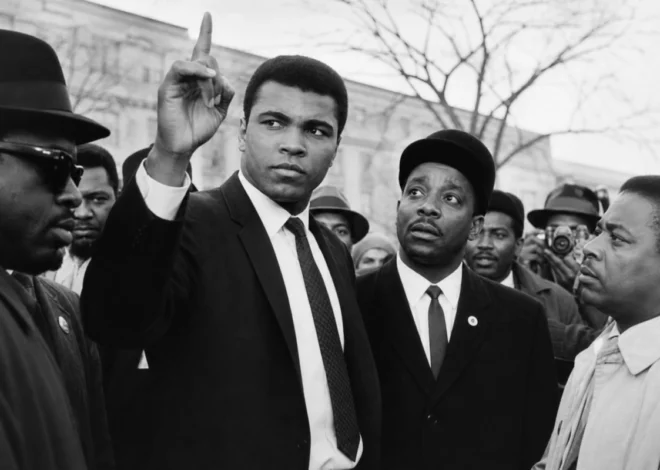
You will find one of the clearest intersections of Ali’s moral and legal stakes in his refusal to be inducted into the U.S. Army in 1967. Citing his religious beliefs and opposition to the Vietnam War—summed up in lines like “I ain’t got no quarrel with them Viet Cong”—Ali declined to submit to the draft. The government treated that refusal as felonious draft evasion. He was convicted, fined, and sentenced to prison; his professional licenses were revoked and boxing organizations stripped him of the heavyweight title he had won only a few years earlier.
Legally, the case became a high-stakes argument about conscience, religion, and state power. Ali appealed through the federal courts, maintaining that his conversion to Islam and his role as a minister in the Nation of Islam made him a conscientious objector. The appeals process stretched years, and in the interim his conviction loomed as both a personal legal jeopardy and a public symbol. When the U.S. Supreme Court finally reversed his conviction in 1971, it vindicated him legally—but the delay had already done its damage to his athletic trajectory.
As you trace this period, note how the courtroom saga did more than determine guilt or innocence. It reframed the terms of national debate about dissent. For many Americans, Ali’s stance was evidence of unpatriotic defiance; for others—especially Black activists, pacifists, and international critics of U.S. foreign policy—it was principled courage. The legal reversal mattered not merely for Ali’s right to box again, but for how the law could be used to protect an individual’s claim to conscience against the demands of state service.
Exile from the ring: athletic costs, tactical evolution, and shifting public opinion
The three-year absence from competitive boxing came at the worst possible time for an athlete: the mid- to late-twenties, when physical prime and public momentum often align. Ali lost lucrative fights, titles, and several peak performance years. His defeat to Joe Frazier in the 1971 “Fight of the Century” was as much an athletic moment as a cultural reckoning—Ali returned to face an undefeated champion and a country that had already pronounced judgment on his politics.
Yet exile also altered Ali’s public profile in complex ways. Outside the ring he became more than a contrarian athlete; he was a living emblem of resistance. Anti-war groups, international leaders, and younger generations found in him a figure who linked Black empowerment to broader anti-imperial and humanitarian struggles. At the same time, mainstream opinion slowly moved: as the war became more controversial and civil-rights victories accumulated, some critics softened, if grudgingly.
Athletically, the hiatus forced adaptations. Ali’s style—once overwhelmingly predicated on speed and audacity—evolved. He developed greater tactical patience and new defensive gambits that would surface in later, famous fights. Those changes reflected a boxer who had lost sharpness but gained strategic depth. In short, the costs of conscience were tangible and immediate: titles, prime years, and earnings. The gains were moral stature, a widened platform, and a legacy that fused sporting greatness with civic consequence.
Return to the ring and the final chapters
Ali returned to boxing as a changed athlete and public figure. His victories and losses in the 1970s—most famously the “Rumble in the Jungle” against George Foreman and the “Thrilla in Manila” against Joe Frazier—cemented his status as a tactical genius and an enduring draw. Outside the ropes he expanded his public role: meeting world leaders, speaking for global causes, and supporting programs for youth and humanitarian relief. As his health declined with a Parkinson’s diagnosis in the 1980s, Ali reoriented much of his energy toward philanthropy and diplomacy, becoming a symbol whose moral authority often outpaced his physical presence. His honors, including a presidential medal and international acclaim, reflected a life that continued to provoke admiration, debate, and emulation.
Why Ali still matters
Muhammad Ali’s life resists simple categorization: he was an electrifying athlete, a polarizing political actor, and a tireless public ambassador. The tensions he embodied—between fame and principle, confidence and humility, spectacle and sacrifice—invite ongoing reflection about the roles athletes play in public life. His choices showed that athletic distinction can amplify moral claims, and that moral claims can reshape cultural narratives even when they exact personal cost.
To explore more about Ali’s life and the broader context of athlete activism, see this concise biography and timeline: Muhammad Ali — Britannica.