Muhammad Ali Civil Rights Activism: How the Champ Fought Inside and Outside the Ring
How a boxer’s rise forced you to rethink fame, race, and political voice
When you first hear Muhammad Ali’s name, you likely think of lightning-fast combinations and poetic trash talk. But by the mid-1960s, his fists were only part of the story. As Ali moved from Olympic gold to the world heavyweight championship, he also became an unmistakable public presence who forced Americans to confront issues of race, religion, and the costs of conscience. Understanding Ali’s early activism helps you see how an athlete’s personal identity can reshape public debate in a time of national upheaval.
The United States of Ali’s ascendancy was a nation in flux: the civil rights movement was winning landmark legal victories even as segregationist resistance persisted, and the Vietnam War was creating new political fault lines. In that environment, Ali did not remain a neutral entertainer. His conversion to Islam, renaming from Cassius Clay to Muhammad Ali, and his often-controversial public statements turned sporting events into platforms for larger moral and political questions.
How Ali’s faith and public image created a new kind of protest
Faith as a lens for justice
You should note that Ali’s alignment with the Nation of Islam (NOI) in the early 1960s was both a spiritual decision and a political declaration. The NOI offered a framework that rejected white supremacy and promoted Black pride, self-sufficiency, and critique of institutional racism. For many Black Americans, that message held deep appeal; for many white Americans and mainstream institutions, it was alarming.
Fame amplified every statement
Because you watched Ali on television and in newsreels, his words reached far beyond typical religious networks. He used interviews, press conferences, and pre-fight banter to make points about dignity, self-respect, and the hypocrisy he saw in U.S. treatment of Black citizens. Rather than soften his public persona to fit expectations, he doubled down on rhetoric that made him both a hero to some and a target to others.
- He openly rejected the idea that athletics require political silence, insisting that his success obliged him to speak for his community.
- He challenged mainstream portrayals of Blackness by cultivating prideful language and a distinct public persona that resisted assimilation into white norms.
- He used media appearances to critique segregation and economic marginalization, sometimes framing those critiques in moral and religious language.
These early choices—faith, a new name, blunt public criticism of racial injustice—set Ali apart from many contemporaries who preferred more discreet paths. By positioning himself where sports, religion, and politics overlapped, he redefined what it meant to be a public figure in an era of racial struggle.
Next, you will examine the pivotal incidents that transformed Ali from provocative celebrity into a full-fledged political symbol — beginning with his refusal to be drafted into the Vietnam War and the legal and cultural consequences that followed.
Refusing the draft: a conscience that cost him a crown
When Muhammad Ali announced in 1967 that he would not be inducted into the U.S. military, it was not a private moral choice—it was a public act that forced the nation to choose a side. His succinct refusal—“I ain’t got no quarrel with them Viet Cong”—did more than explain his objection to the Vietnam War; it linked the conflict to the lived realities of Black Americans who were denied justice at home. For Ali, the war was inseparable from racial oppression: why should a Black man fight for freedoms abroad that were denied to him in his own country?
The consequences were immediate and severe. Sporting commissions stripped him of his heavyweight title and his boxing license. He was indicted, convicted of draft evasion, fined, and faced the possibility of imprisonment. That legal fight would ultimately travel through the courts and national debate; in the meantime, Ali was banished from the ring during what should have been the peak years of his career. The penalties were not abstract—financial ruin, social ostracism, and the loss of his primary platform were real costs he knowingly accepted because his protest demanded a sacrifice.
But the refusal itself reframed civic obligation. Ali’s stance raised questions about patriotism, religious liberty, and the limits of dissent. He did not couch his objection in purely legalistic or academic terms; he spoke as a man whose faith, politics, and sense of communal responsibility were inseparable. That clarity made him unbearable to some and indispensable to others. You could no longer treat famous athletes as neutral entertainments; Ali had made the athlete’s body a site of moral argument.
Exile as platform: legal battle, community work, and a new model of activism
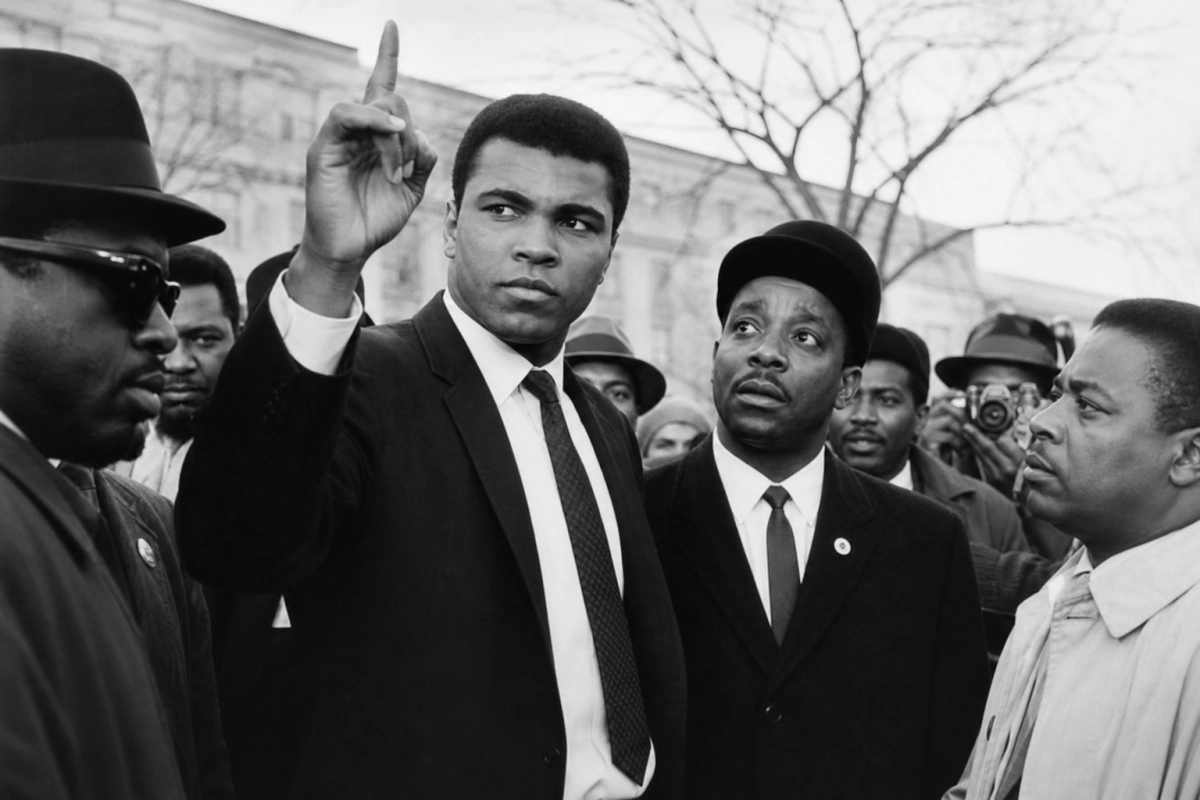
Forced out of the ring, Ali transformed exile into an organic extension of his activism. Deprived of fights, he invested his time in speaking tours, community visits, and alliances with Black leaders and anti-war organizers. He traveled to urban neighborhoods, churches, and college campuses—places where people were already grappling with questions of race, poverty, and U.S. foreign policy—and amplified those conversations with the authority of someone who had willingly taken a public stand.
The legal battle against his conviction became itself a political event. Supporters argued that his refusal on religious grounds raised important First Amendment questions; opponents framed it as sheer unpatriotic defiance. Either way, the courtroom drama kept Ali’s name in headlines for reasons far removed from gloves and belts. When the courts finally reversed his conviction years later, the vindication did not simply reopen a career; it confirmed that the forms of protest he embodied—faith-informed dissent and celebrity-led political speech—were defensible under the law.
During those years Ali also helped normalize a different kind of public figure: one who would not separate athletic achievement from moral judgment. Younger activists and athletes saw in his exile a template for principled resistance. He connected civil-rights rhetoric to anti-imperialist language, nudging the national discourse to recognize that racial justice and opposition to an unpopular war were intertwined. Whether you agreed with him or not, Ali’s exile taught the country a new calculus: that losing a title could be a deliberate tactic for winning a larger argument about justice.
Legacy and influence beyond the ring
Muhammad Ali’s activism did not end when his boxing career wound down. In later decades he became a global ambassador for peace, humanitarian causes, and interfaith dialogue, meeting with leaders and communities around the world and supporting initiatives on poverty, education, and health. His public life evolved from confrontational protest to a form of moral witness that combined charisma with compassion.
Ali’s example reshaped expectations for public figures. Young athletes and celebrities now more readily see platforms as responsibilities; movements for racial justice, religious freedom, and anti-war protest have repeatedly invoked his name and example. Institutions have preserved his memory and used it to inspire civic engagement—you can explore one such institution at the Muhammad Ali Center.
- He helped normalize athlete-led advocacy that connects personal conviction with public action.
- His life showed how sacrifice—legal, professional, and personal—can be deployed strategically to shift public debate.
- His later humanitarian work modeled how a polarizing figure can still foster reconciliation and sustained civic contribution.
Closing reflections
Ali’s life resists neat classification: hero and provocateur, saint and sinner in the eyes of different publics. What endures is not a tidy legacy but a set of questions he forced the nation to keep asking about conscience, courage, and the cost of speaking truth to power. Whether you agree with every stance he took or not, his example invites you to consider when personal conviction should outweigh convenience, and how public platforms can be used to press for change. That tension—that demand for moral clarity in an often ambiguous world—is perhaps the most vital part of what he left behind.