Muhammad Ali Biography and Civil Rights Activism: Athlete, Icon, Advocate
Why Muhammad Ali Still Matters to Sports and Social Justice
You approach Muhammad Ali’s story wanting more than fight records and highlight reels; you want to understand how a boxer became a global voice on race, religion, and conscience. Born Cassius Clay in Louisville, Kentucky, Ali combined relentless self-promotion with an unapologetic moral core. From his earliest days in the ring, he used speed, skill, and charisma to win attention — and he would soon use that platform to shape public debate.
As you read about Ali, note how his athletic achievements and public stances were inseparable. His athletic identity gave him credibility and reach; his convictions gave him consequences and controversy. Early moments in his life planted the seeds for the activist he became: encounters with segregation in the South, the influence of Black community leaders, and a personal embrace of faith and dignity.
Formative Years: Louisville Streets, the Ring, and a New Identity
You can trace Ali’s transformation back to a single childhood incident: a stolen bicycle that led a grieving 12-year-old to a local police officer who recommended boxing as a way to channel his energy. Under the guidance of trainer Joe Martin, you see a focused young athlete develop into one of the finest amateur boxers in the country. His amateur success culminated in a gold medal at the 1960 Rome Olympics, a milestone that introduced him to an international audience.
Early Achievements That Built a Platform
- You learn that his amateur pedigree — including regional titles and national recognition — gave him an early reputation for speed, reflexes, and showmanship.
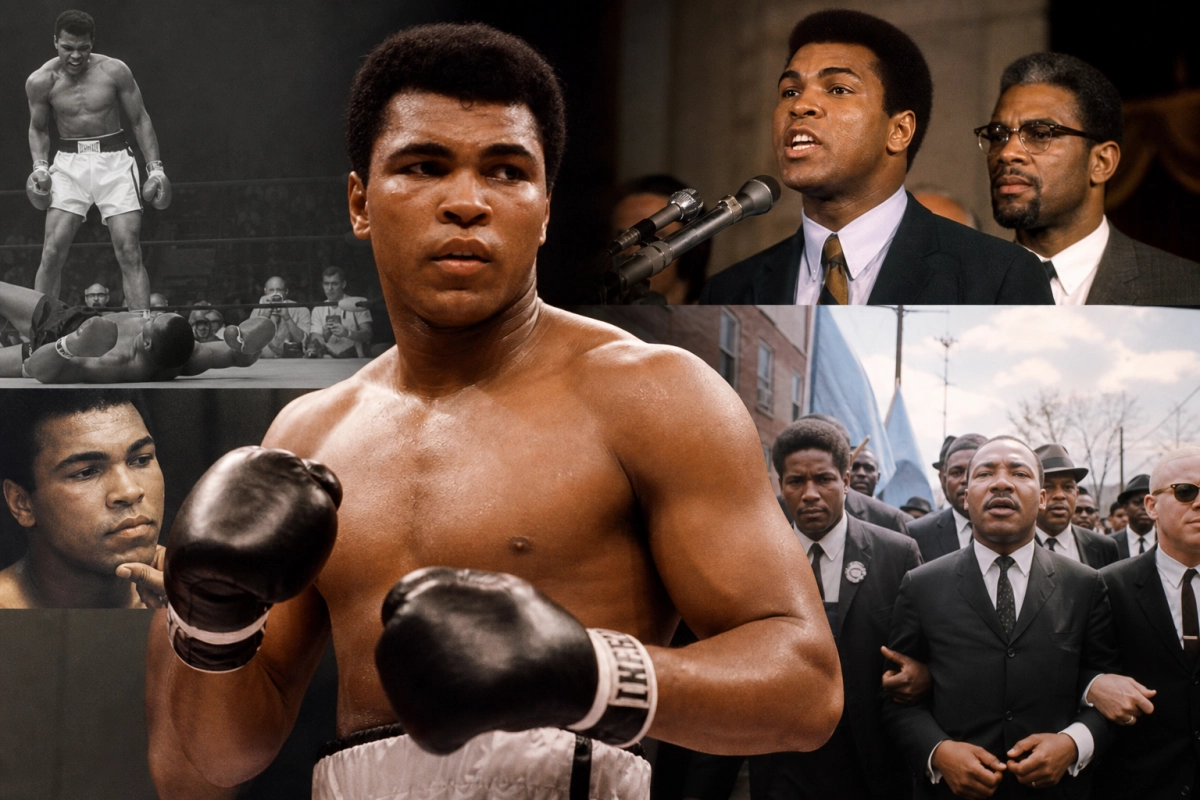
- At age 22 he shocked the boxing world by defeating Sonny Liston to claim the world heavyweight title, a victory that thrust him into celebrity and controversy.
- Almost immediately after that triumph, he announced a new name and a new allegiance: Cassius Clay adopted the name Muhammad Ali after joining the Nation of Islam, signaling a public alignment of religion and identity that would shape his public life.
Those early choices mattered. When you consider why Ali’s voice carried weight, remember that he was not only a champion inside the ring but also someone who consciously recast himself as a representative of Black dignity and religious conviction. His image — brash, articulate, and unbowed — made him both a hero to many and a lightning rod for criticism from others who expected athletes to remain apolitical.
By the mid-1960s, the stage was set: you see a global sports icon who had already begun to define himself beyond wins and losses. His name change, public faith, and willingness to speak on race and religion positioned him at the crossroads of sport and social struggle — a crossroads that would deepen dramatically as he faced the draft and the legal consequences that followed.
In the next section, you’ll examine Ali’s refusal to be drafted, the legal battle that stripped and then restored his title, and how those events expanded his role from celebrated athlete to outspoken civil rights advocate.
Refusal to Fight: Draft Resistance and the High Cost of Conscience
When you look closely at the moment Ali refused induction into the U.S. Army in 1967, it reads less like a stunt and more like a calculated act of conscience. He didn’t couch his refusal in vague pacifism; he famously said, “I ain’t got no quarrel with them Viet Cong,” framing his objection in terms of racism at home and his religious beliefs abroad. Citing his membership in the Nation of Islam and his understanding of Islam’s teachings, Ali applied for conscientious-objector status. The government denied it; the stakes were immediate and severe.
You can see how the response escalated quickly. Prosecutors indicted him for draft evasion, a jury convicted him, and he was sentenced to five years in prison (a sentence he would not serve while appeals moved forward). More publicly consequential was what followed in the athletic sphere: boxing commissions stripped him of his title, licenses were suspended, and the young champion who once taunted opponents with confident verse found himself barred from the ring at the height of his powers. For the next three and a half years, Ali’s public life shifted from slick ringside interviews to courtroom hearings and a sustained media storm.
That exile was also a crucible. You watch a champion go from center stage to symbol; the legal battle crystallized the issues he had long been raising about race, religion, and the obligations of citizenship. In 1971 the Supreme Court reversed his conviction in Clay v. United States, a judicial vindication that allowed Ali to return to the ring. But by then the shape of his career — and of his moral authority — had changed. The price he paid had widened his platform: he was no longer only a boxer who spoke; he was a public conscience whose experiences of discrimination and punishment lent weight to his critiques.
Return to the Ring and the Expansion of a Public Mission
When Ali re-entered professional boxing, he did so amid the intense drama of a nation still divided over Vietnam, civil rights, and cultural change. You watch how his in-ring comebacks — the 1971 “Fight of the Century” against Joe Frazier, the 1974 “Rumble in the Jungle” against George Foreman — read as more than sporting events. They were spectacles in which personal redemption, racial pride, and international politics intersected. Ali’s tactics, personality, and talk kept crowds riveted; his victories and defeats reverberated far beyond the ropes.
More importantly, his voice off the canvas grew broader. The exile experience had deepened his credibility among anti-war activists and young Black nationalists; it also pushed him into global conversations. You find Ali meeting world leaders, visiting communities affected by conflict, and using celebrity to highlight human suffering and injustice. Even when his fame brought criticism — from those who argued athletes should stay out of politics, or who disagreed with his religious views — his willingness to accept legal and professional cost amplified his message.
As you follow this period, notice how Ali’s public identity matured from brash provocateur to elder statesman of sorts. The fights he chose—and the causes he voiced—mapped onto a larger career of advocacy that would outlast his competitive prime. His physical decline in later decades would not erase the influence of these years; if anything, the narrative of sacrifice and comeback helped cement Ali as a complex symbol: elite athlete, controversial dissident, and enduring advocate for dignity and conscience.
Later Years, Health, and Humanitarian Reach
After retiring from the ring, Ali turned more of his energy to travel, charity, and quiet diplomacy. He supported causes ranging from humanitarian relief to education, using his celebrity to raise funds and attention for vulnerable communities. In 1984 he was diagnosed with Parkinson’s syndrome, a condition that progressively limited his public appearances but did not silence the respect he commanded. Even as his voice softened, his presence continued to draw attention to issues of dignity and human rights, and he remained a symbol of resilience for millions.
How Culture Remembers Him
Ali’s likeness and language have been absorbed into music, film, literature, and political rhetoric. Artists and activists alike have quoted his lines, debated his stances, and invoked his example when confronting questions about conscience and representation. Museums and centers preserve his artifacts and stories, inviting new generations to wrestle with the same tensions he embodied: fame and responsibility, spectacle and sacrifice.
Enduring Questions
Muhammad Ali’s life resists tidy conclusions. He leaves behind an example that is as challenging as it is inspiring: a reminder that moral conviction can come with cost, that public platforms alter responsibility, and that personal faith can drive public action. How we interpret his choices—celebrate them, critique them, or do both—says as much about our own era as it does about his.
If you want to explore artifacts, speeches, and educational programs that continue to shape conversations about his influence, visit the Muhammad Ali Center to see how his life is preserved and presented for new audiences.